
ROI ↔ Voxel Research connection
Two complementary representation routes: Brain-DiT learns from atlas-defined ROI signals; Omni-fMRI learns directly from voxel volumes.
MODELS · METHODS · DATA
Explore how our projects connect brain representations, learning strategies and whole-brain dynamics.
Hover a project or connection to explore. Click a project to read its story.
Swipe across the map. Tap a project to open it.
Voxel volumes, ROI time series and cortical surfaces offer different routes into brain activity. Explore a project or connection to follow the research.
How can one voxel-level representation transfer across fMRI datasets?
How can a model learn across different brain states?
Can existing vision models provide useful features for fMRI?
Which moments need expensive voxel-level computation?
How can one encoder handle heterogeneous acquisition resolutions?
Can individual anatomy guide whole-brain fMRI dynamics?
Can learned voxel features help discover individual brain parcels?
Under a fixed budget, should we scale data, models or training time?
What should we pretrain on, and which tasks should we transfer?
Two complementary representation routes: Brain-DiT learns from atlas-defined ROI signals; Omni-fMRI learns directly from voxel volumes.
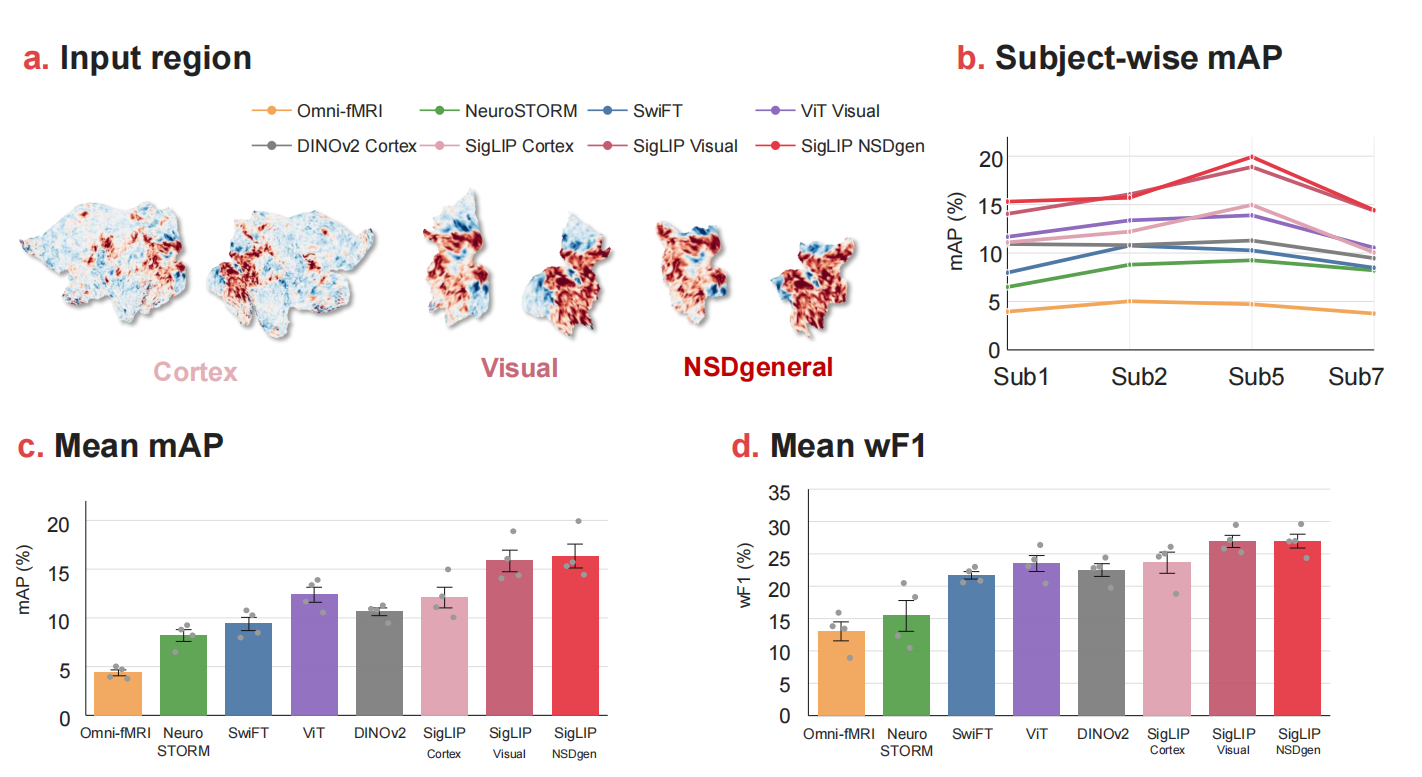
Two spatial interfaces: FlatClip reuses a vision encoder through cortical flatmaps; Omni-fMRI learns directly from voxel volumes.
Different interfaces expose different spatial information: ROI time series for Brain-DiT and cortical flatmaps for FlatClip.
SLIM-Brain advances efficient voxel learning through time-window routing and sparse Hiera-JEPA computation.
FlexiBrain extends voxel learning to native space and heterogeneous resolutions with Mamba-JEPA.
From ROI-level conditional diffusion in Brain-DiT to anatomy-conditioned, whole-brain voxel dynamics in BrainWorld.
Voxel representation meets brain organization: DCA uses pretrained Swin-UNETR features and a spatial graph to discover individual parcels.
Two ROI-level learning studies: Scaling controls the NeuroJEPA training budget; Brain-DiT learns representations through conditional diffusion.
Direct methodological reuse: BrainTaskonomy uses a lightweight Brain-DiT proxy to estimate domain difficulty and directed facilitation.
Preserve spatial detail, adapt to acquisition differences, and make long recordings tractable.
Explore conditional generation, whole-brain dynamics and individualized brain parcels.
Compare model reuse, training budgets and task-transfer strategies.
A structural prior brings anatomy and four-dimensional brain activity into one generative framework.
Explore BrainWorld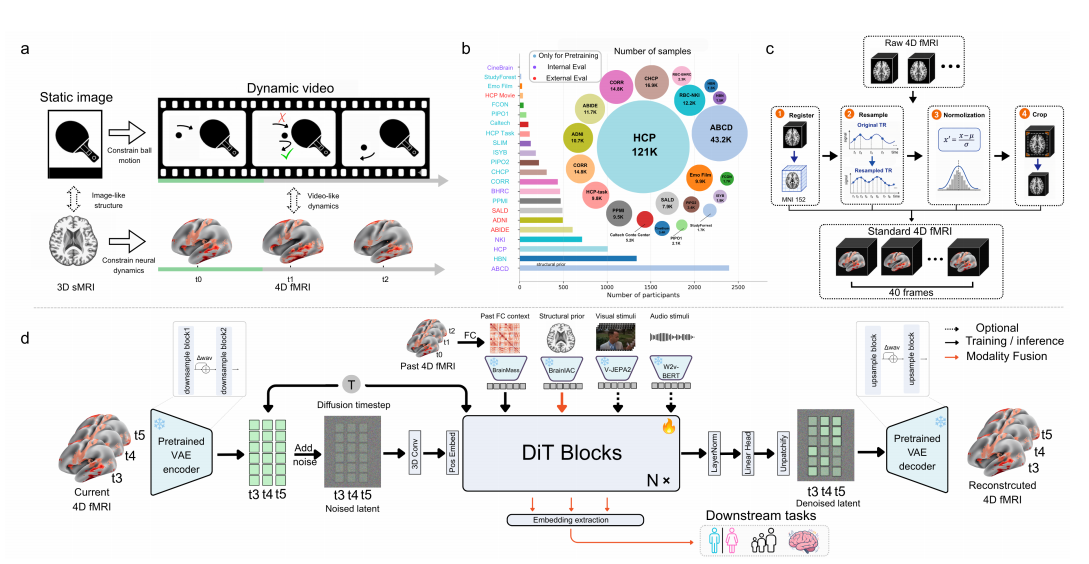
Content-adaptive voxel patches preserve spatial detail while making large-scale pretraining more efficient.
Explore Omni-fMRI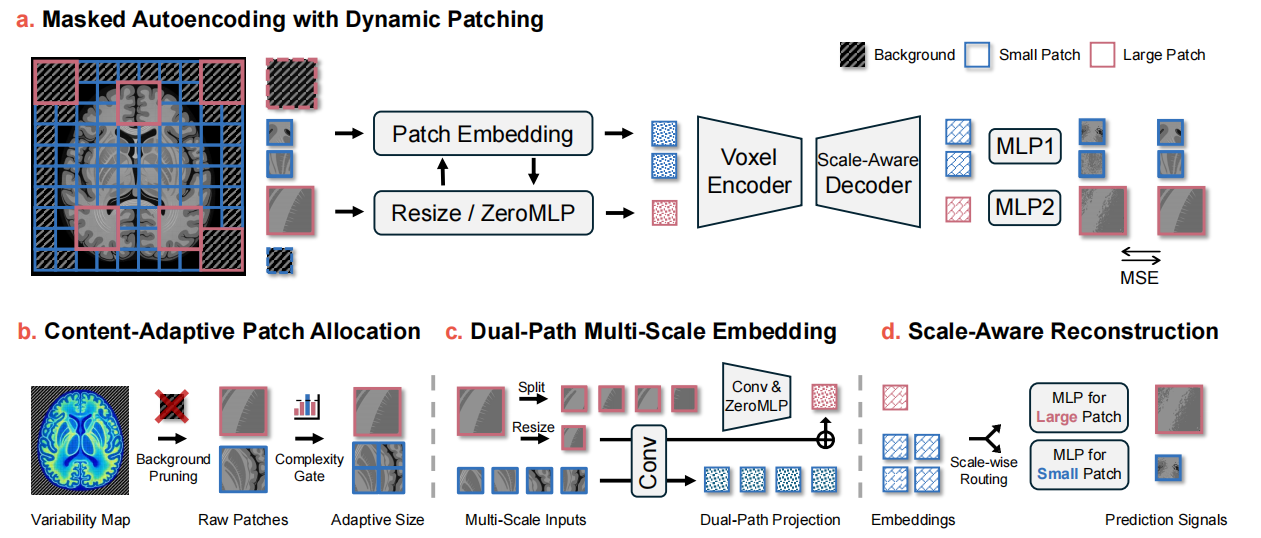
Metadata-conditioned diffusion connects resting, task, and naturalistic fMRI in a shared representation framework.
Explore Brain-DiT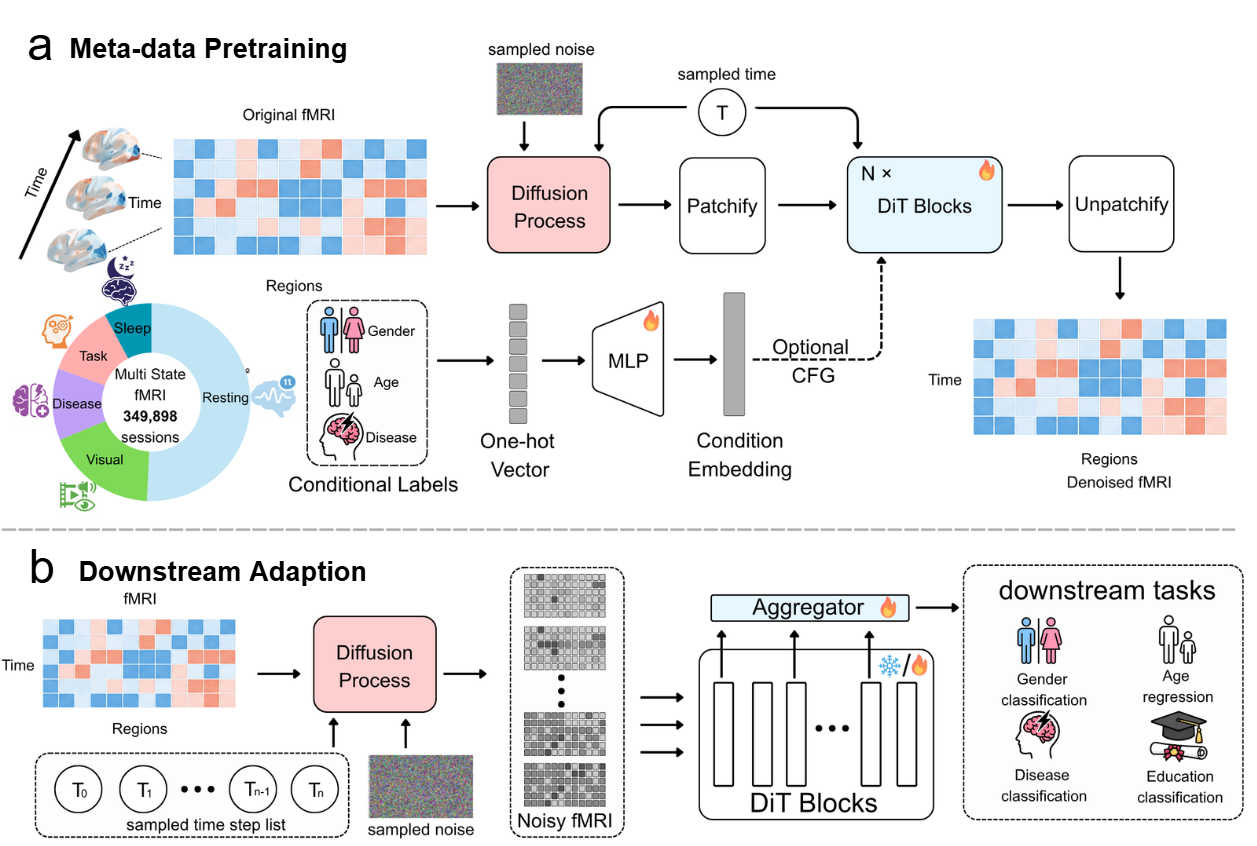
Learn from native-space fMRI across different resolutions with physical-space patching and a Mamba-JEPA encoder.
Explore FlexiBrain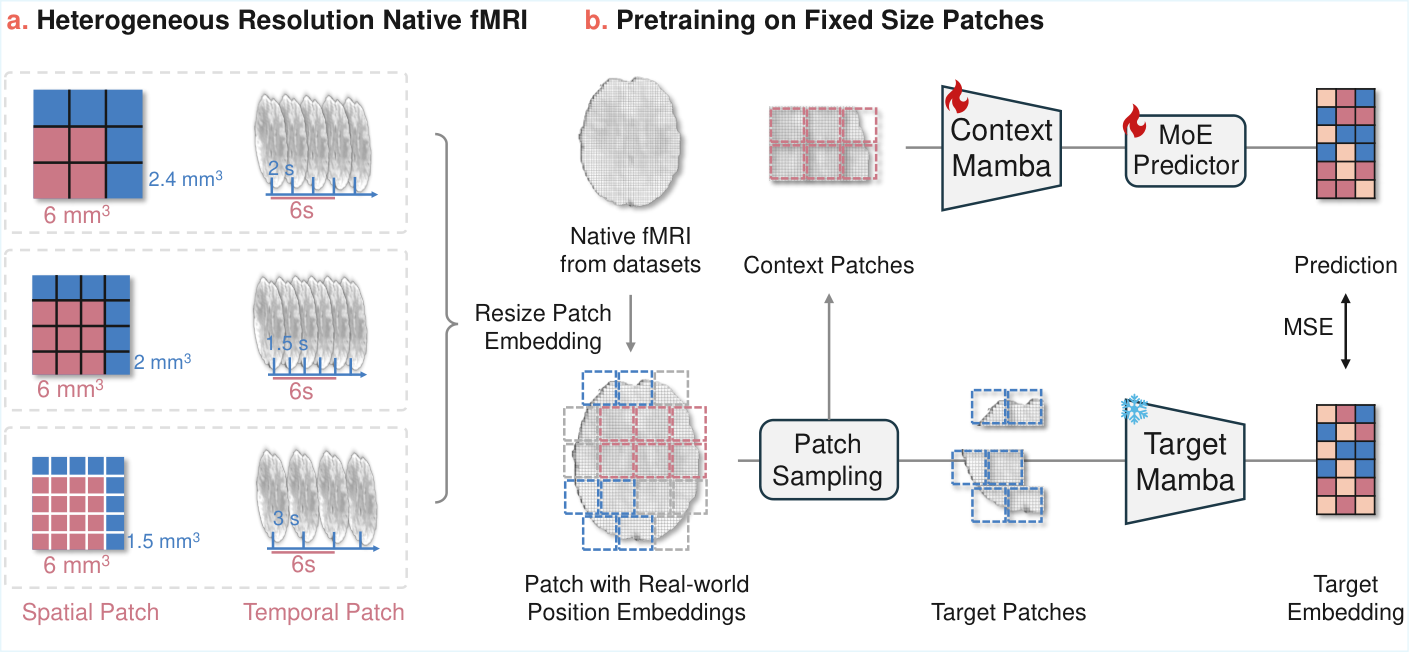
Explore projects by modality
and research purpose.
 Explore research
Turn cortical activity into flatmap sequences and reuse a frozen vision encoder for a lightweight surface-based learning baseline.
Learn more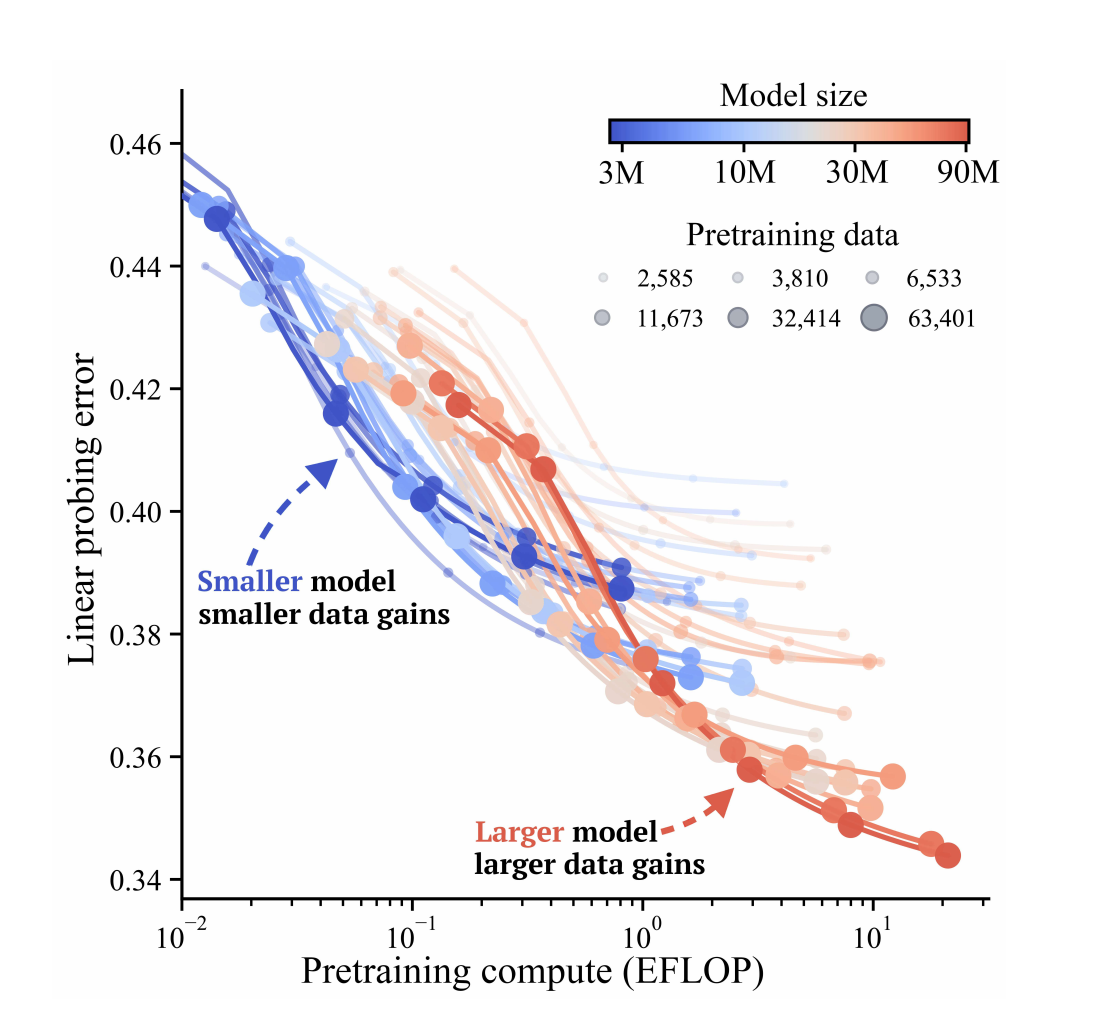 Explore research
A controlled study of how data, model size and training duration affect generalization in fMRI foundation models.
Learn more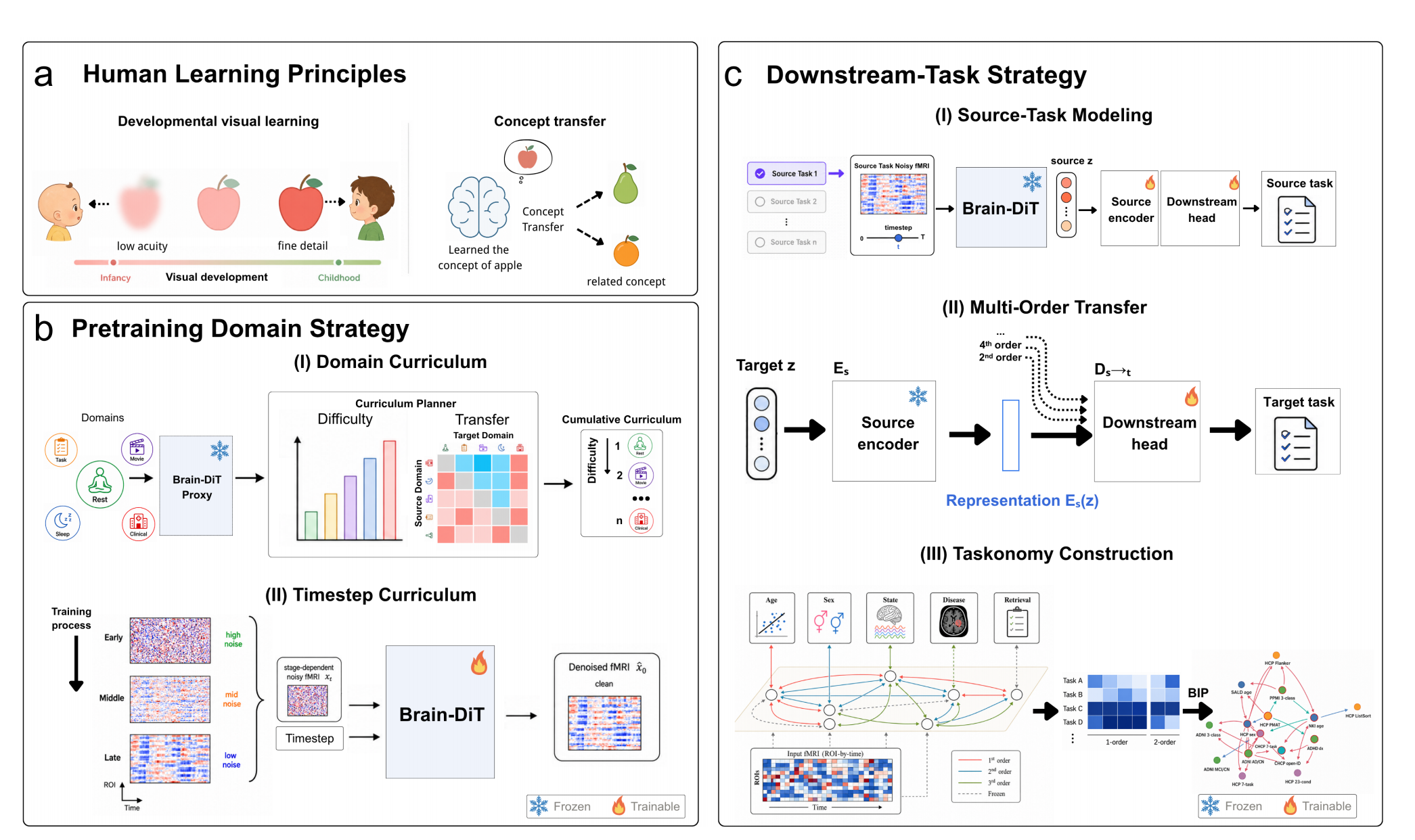 Explore research
Organize pretraining domains and downstream transfer with measured task relationships, curriculum learning and budget-aware source selection.
Learn moreExplore research Metadata-conditioned diffusion pretraining brings resting-state, task, naturalistic and other brain states into a shared representation framework.
Learn moreExplore research Use individual brain anatomy as a structural prior to generate whole-brain fMRI dynamics across space and time.
Learn moreLearn from native-space fMRI across different resolutions with physical-space patching and a Mamba-JEPA encoder.
Learn moreExplore research Atlas-free brain representations with content-adaptive voxel patches. Preserve spatial detail while making large-scale pretraining more efficient.
Learn more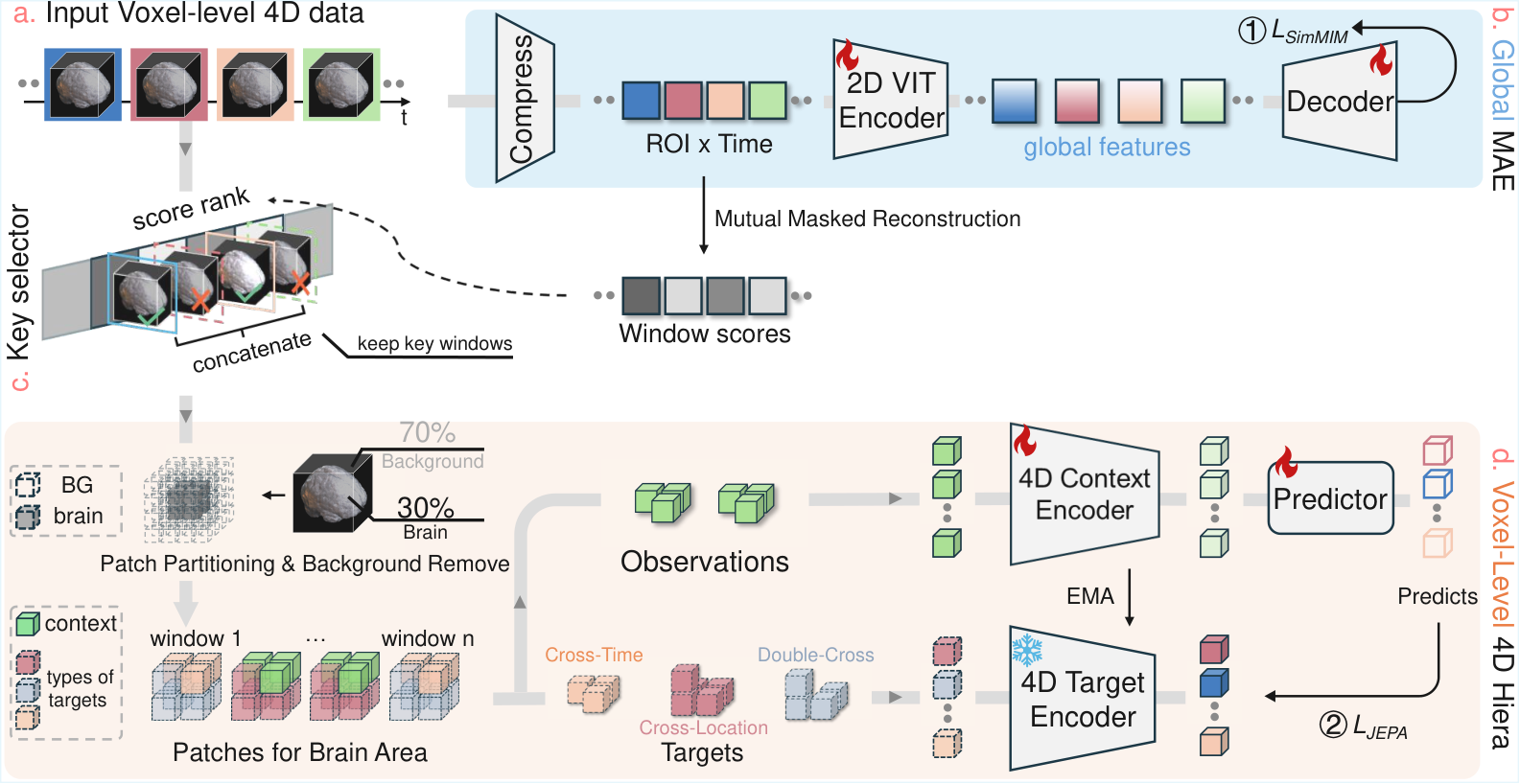 Explore research
Route informative temporal windows to a hierarchical encoder to reduce the cost of voxel-level fMRI representation learning.
Learn more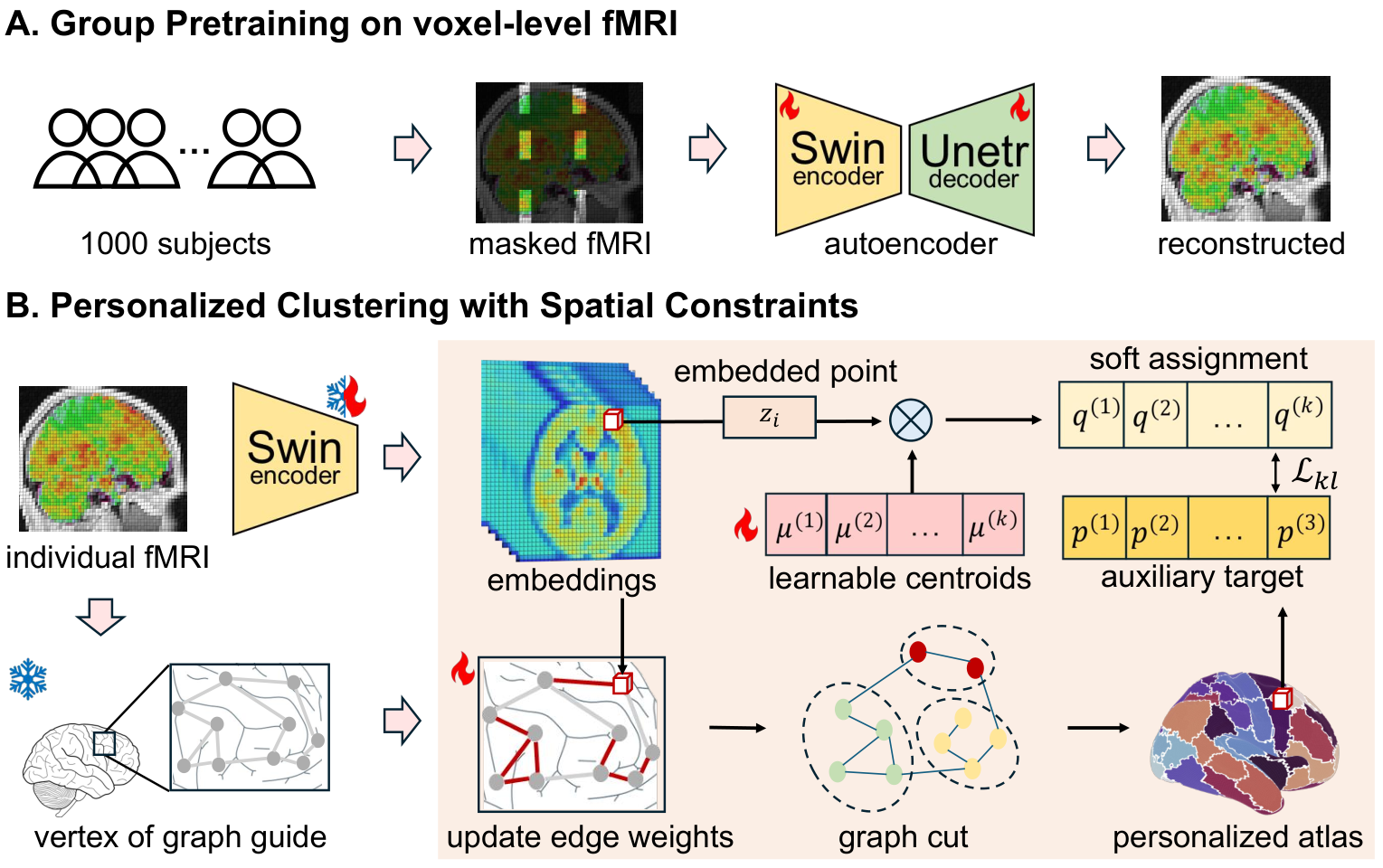
Build personalized voxel-level brain atlases with pretrained fMRI embeddings and spatially guided clustering.
Learn moreTry another modality, purpose or keyword.
Explore 45 data collections and paper-specific cohorts, with source links, access conditions, and reported scale.
Explore the collectionsOur research in brain representations, dynamics and spatial organization, with the papers, models and data behind each project.