
Where should a voxel-level model spend its budget?
Voxel-level fMRI preserves spatial detail that regional averaging can hide, but a long recording repeats a large three-dimensional volume at every time point. A dense encoder can spend memory on background, redundant moments and masked units that do not all need the same detailed computation.
SLIM-Brain separates two decisions: which parts of the recording deserve a closer look, and which spatial units need to enter the expensive encoder. A lightweight global branch first surveys the time series. A sparse voxel branch then learns detailed features from selected windows. The goal is useful transfer with a smaller data and memory budget.
Two kinds of selectivity: across time and within a volume
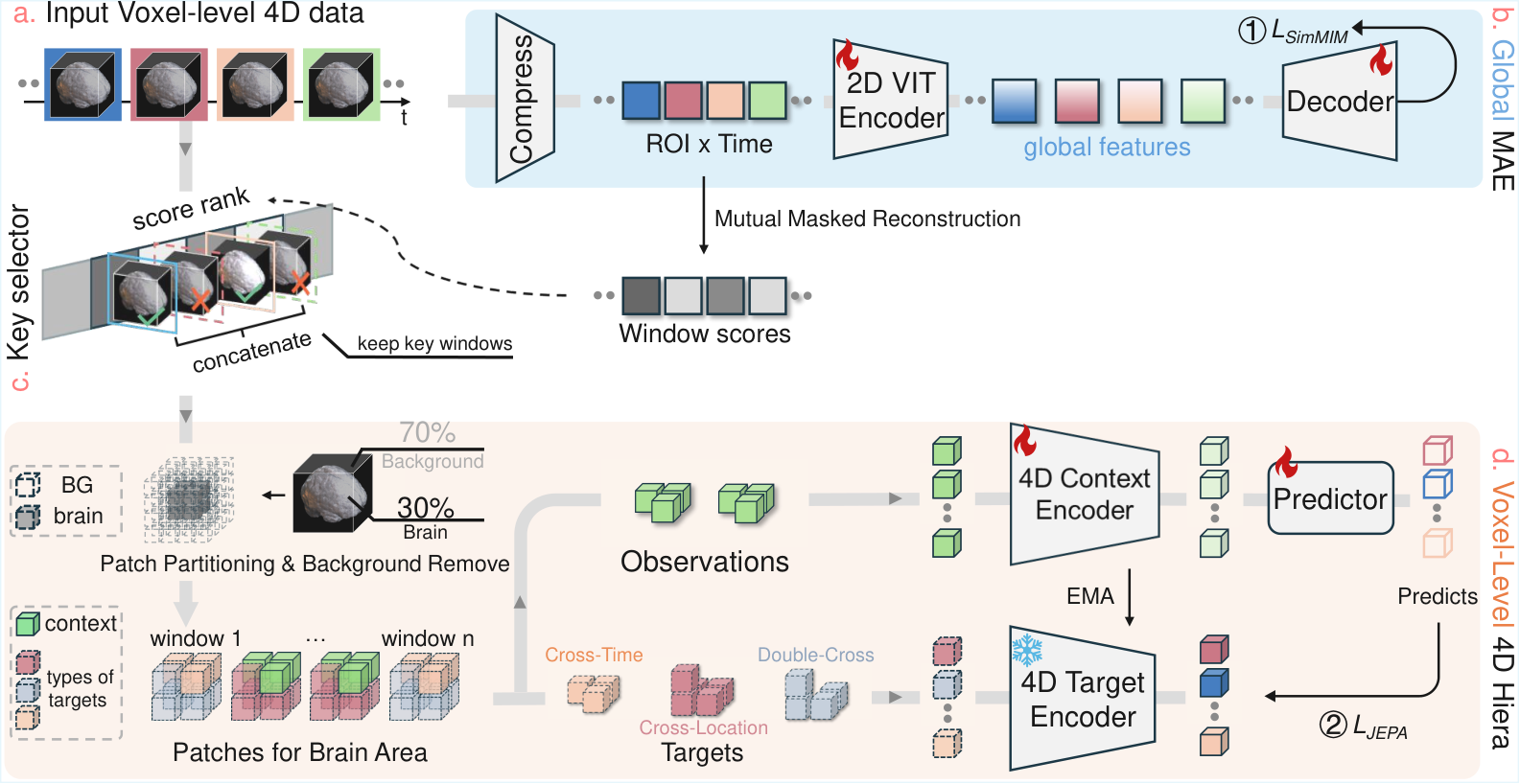
Read the original framework figure as a routing pipeline. The whole recording is used for a coarse temporal overview, but only selected windows receive detailed 4D encoding. Downstream predictions use features from the voxel encoder; the global branch decides where that encoder should look.
Rank representative time windows
A lightweight global masked autoencoder scores windows through mutual masked reconstruction: how well does a window help represent the rest of the recording? It selects the top-k windows instead of sending the entire dense sequence to the voxel encoder. Representative does not necessarily mean the most intense or task-evoked moment.
Skip units before expensive spatial processing
The selected windows enter a 4D Hiera encoder. Non-brain background and masked units are excluded from the corresponding encoder inputs rather than processed as a complete dense grid. This spatial sparsity complements temporal routing: fewer moments receive detailed encoding, and fewer units within them require activations.
Learn features without a heavy voxel decoder
Hiera-JEPA predicts target-branch latent features from context features rather than reconstructing a full raw volume. Pooled voxel features form the downstream descriptor. This is a third efficiency choice alongside routing and sparsity; the global overview is not used as the final prediction feature.
Measure memory savings and representation quality separately
The default 45M-parameter model is pretrained on 4,129 sessions. External evaluation adapts it to ABIDE, ADHD-200, ADNI and PPMI. The experiments also isolate window selection and encoder design, so efficiency is linked to specific choices rather than only to an overall model score.
Selecting windows is better than dropping them arbitrarily
In the ADHD linear-probing ablation, top-k selection reaches 61.1% accuracy, compared with 56.0% for random selection. This tests the temporal router: reducing the number of windows is useful only if the remaining windows retain task-relevant information.
Less memory does not mean every score increases
For the 1K-pretraining, 200-frame architecture comparison, Hiera-JEPA uses 2.3 GB per sample, versus 8.0 GB for Swin-SIM. HCP fingerprint accuracy improves substantially, while HCP sex accuracy changes little and ABIDE age accuracy remains below Swin-JEPA. The approximately 30% memory figure therefore describes a measured memory footprint, not a universal speedup or an across-the-board accuracy gain.
| Encoder / objective | GPU memory · GB ↓ | HCP fingerprint · ACC % ↑ | ABIDE age · ACC % ↑ |
|---|---|---|---|
| Swin-SIM | 8.0 | 38.2 | 59.3 |
| Swin-JEPA | 4.0 | 84.0 | 62.1 |
| Hiera-MAE | 2.4 | 90.0 | 52.6 |
| Hiera-JEPA | 2.3 | 98.5 | 59.6 |
Preserve informative detail without encoding everything densely
SLIM-Brain's efficiency comes from selective temporal input, sparse spatial processing and latent prediction working together. Its representative-window score is well suited to recurring patterns, but the paper notes that unique task-evoked moments may be down-weighted. For event-focused studies, window selection therefore deserves its own validation alongside the downstream model.
Explore the design and its experimental trade-offs
Start with the routing and sparse-encoder sections, then compare the window-selection and architecture ablations. The paper explains the design and experiments; this collection currently has no public code or checkpoint link for SLIM-Brain.
Read the study
Explore temporal routing, sparse learning and evaluation.
No public link listed
Refer to the paper for the implementation details.
No public link listed
No downloadable checkpoint is linked in this collection.
SLIM-Brain: A Data- and Training-Efficient Foundation Model for fMRI Data Analysis
Research post by fMRI Atlas, based on the original study linked above.
Post updated:
Read the paper’s abstract
Foundation models are emerging as a powerful paradigm for fMRI analysis; however, current approaches are hindered by a dual bottleneck in data and computational efficiency. Atlas-based methods aggregate voxel signals into fixed regions of interest (ROIs), which reduces dimensionality but discards fine-grained spatial details and necessitates massive cohorts for effective pre-training. Conversely, atlas-free methods operate directly on voxel-level data to preserve spatial fidelity, but their memory and compute requirements often make end-to-end voxel-level processing of full-length fMRI sequences impractical. In this work, we introduce SLIM-Brain, an atlas-free foundation model that uses a lightweight global encoder to score temporal windows from long fMRI recordings while applying voxel-level computation only to the selected windows. SLIM-Brain adopts a two-stage adaptive design: (i) a lightweight temporal extractor ranks windows by how well they represent the remainder of the recording, and (ii) a 4D hierarchical encoder (Hiera-JEPA) learns fine-grained voxel-level representations only from the top-k representative windows while pruning approximately 70% of non-brain or masked units. The downstream predictor uses the voxel-level descriptor; the global encoder is used only for routing. Extensive experiments across external public benchmarks show that SLIM-Brain achieves strong performance on diverse tasks while requiring only about 4 thousand pre-training sessions and approximately 30% of the GPU memory used by Swin-based voxel-level models.
BibTeX
@misc{slimbrain2025,
  title={SLIM-Brain: A Data- and Training-Efficient Foundation Model for fMRI Data Analysis},
  author={Wang, Mo and Xia, Junfeng and Ye, Wenhao and Liu, Enyu and Peng, Kaining and Feng, Jianfeng and Liu, Quanying and Wen, Hongkai},
  year={2025},
  eprint={2512.21881},
  archivePrefix={arXiv},
  url={https://arxiv.org/abs/2512.21881}
}