
Why warp every scan before learning from it?
Putting each brain into a common template makes voxel correspondence and batching easier. It also adds registration and interpolation steps that alter the subject's original geometry. FlexiBrain asks whether a shared model can instead learn in native space, retaining each scan's acquisition grid and avoiding nonlinear warping to a population template.
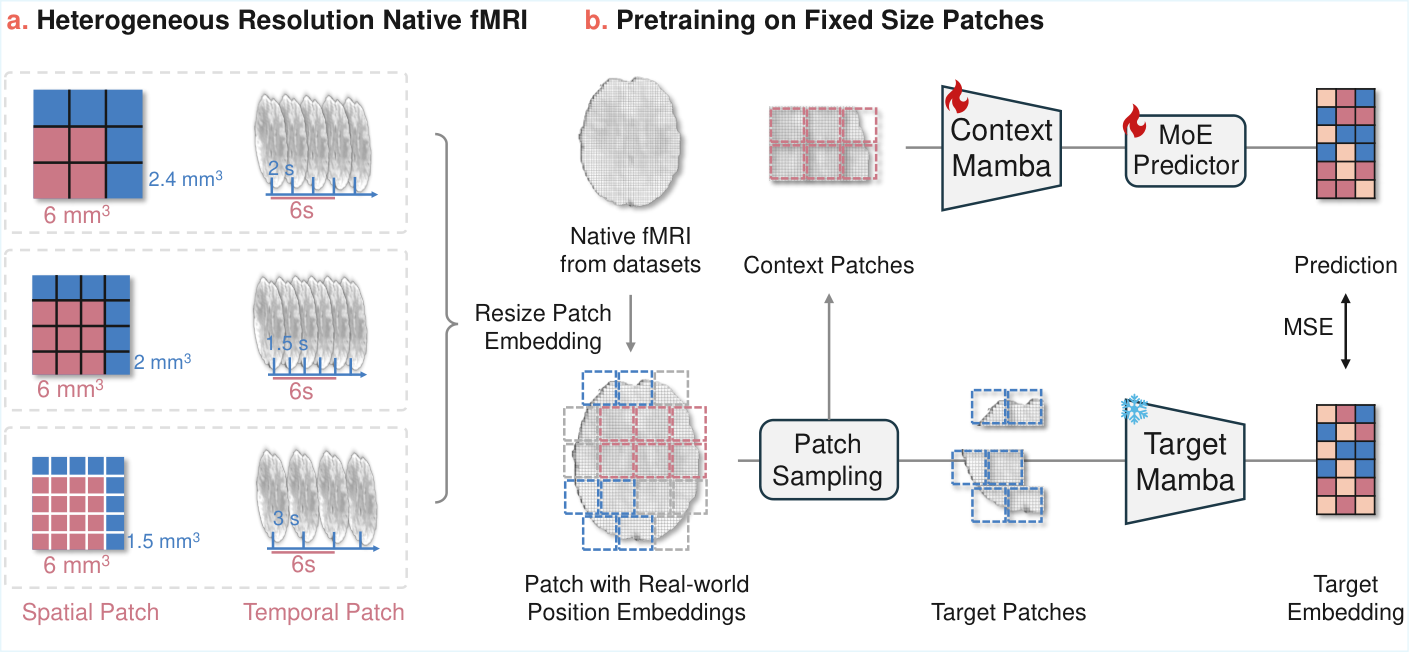
Keeping the original grid creates a new modeling problem. A four-voxel patch spans 12 mm at 3 mm resolution, but only 8 mm at 2 mm resolution. A fixed number of time points also represents different durations when the repetition time (TR) changes. The same tensor shape therefore need not represent the same physical extent.
Share physical receptive fields, not fixed voxel counts
FlexiBrain reads the scan's voxel spacing and TR to decide how to form tokens. In the original framework figure, native-space volumes become resolution-aware patches, then context and target branches learn a shared latent representation. A lightweight prediction head adapts these features for a downstream task.
Define patches in millimeters and seconds
Patch extent is specified in physical units. Shared embedding kernels are resized for the required number of voxels and frames, rather than learning a separate tokenizer for every resolution. Position information is also expressed in physical coordinates. This shares parameters across scans without first resampling all inputs to one acquisition grid.
Predict missing features with Mamba-JEPA
The context branch processes visible patches and predicts the latent features of masked patches supplied by a moving-average target encoder. Mamba models the long voxel-token sequence. Predicting features rather than reconstructing every raw voxel avoids a reconstruction target whose dimensionality changes with resolution.
Make the context pathway token-adaptive
A mixture-of-experts module transforms context tokens before prediction. It adds asymmetry to the context and target pathways and helps avoid representation collapse, where different inputs produce the same feature. The result is one shared encoder with scan-aware input preparation, not a different model for each acquisition protocol.
Separate resolution handling from dataset transfer
ABIDE, ADHD-200 and ADNI supply mixed-resolution pretraining data. Evaluation covers ASD and ADHD classification, two ADNI tasks, and a three-class PPMI task. PPMI is excluded from pretraining, so its downstream adaptation tests transfer to a new dataset.
External prediction with heterogeneous inputs
On PPMI, FlexiBrain reaches 74.31% accuracy and 70.54% F1. Table 1 reports the highest mean accuracy in four of the five task columns; NeuroSTORM is stronger on ADNI AD classification. This gives a more useful picture than treating every diagnosis task as the same result.
Test the preprocessing choice directly
The study separately trains models from scratch with native, T1w-aligned and template-space inputs. Figure 3 reports the strongest accuracy for the native setting and a reduction in preprocessing time from about five hours to three minutes in that comparison. These results test the input pipeline separately from pretrained-model transfer.
| Task | FlexiBrain · ACC ↑ | Highest compared baseline · ACC ↑ |
|---|---|---|
| ADHD-200 | 69.76 ± 1.75% | SwiFT · 62.50 ± 1.50% |
| ABIDE · ASD | 65.45 ± 0.69% | BrainMass · 63.33 ± 1.18% |
| ADNI · MCI vs. CN | 79.16 ± 1.48% | NeuroSTORM · 66.67 ± 1.06% |
| ADNI · AD vs. CN | 82.34 ± 2.39% | NeuroSTORM · 84.26 ± 0.80% |
| PPMI · external dataset | 74.31 ± 1.77% | NeuroSTORM · 68.25 ± 1.18% |
Native space becomes a workable model input
FlexiBrain addresses the tension between keeping individual geometry and sharing model parameters across acquisitions. Resolution-aware tokenization makes that possible. It does not make resolution or scanner differences disappear: controlled downsampling lowers performance, and the stricter held-out scanner-center test remains difficult. Correct voxel spacing and TR are therefore part of using the model.
Keep the acquisition information with the scan
Prepare native-space fMRI using the repository's workflow and retain the voxel spacing, TR and physical-coordinate information needed by the tokenizer. Native-space modeling removes the requirement for nonlinear template warping; it is not a replacement for input preparation or quality control.
Resolution-Agnostic Voxel-Level Encoding for Native fMRI
Research post by fMRI Atlas, based on the original study linked above.
Post updated:
Original overview
FlexiBrain learns voxel-level representations from native-space fMRI acquired at different spatial and temporal resolutions. It specifies patch sizes in physical units and resizes shared embedding kernels to match each scan, allowing one encoder to handle heterogeneous acquisitions without first warping every subject to a common template. A Mamba-JEPA backbone learns by predicting masked latent features rather than reconstructing the raw signal. A mixture-of-experts module in the context branch helps stabilize learning. The study evaluates five diagnostic tasks across ABIDE, ADHD-200, ADNI and PPMI, with PPMI used as an external dataset.
Summary of the original paper, submitted June 9, 2026.
BibTeX
@misc{wang2026flexibrain,
  title={FlexiBrain: Resolution-Agnostic Voxel-Level Encoding for Native fMRI},
  author={Wang, Mo and Ye, Wenhao and Xia, Junfeng and Xu, Minghao and Wen, Hongkai and Liu, Quanying},
  year={2026},
  eprint={2606.11500},
  archivePrefix={arXiv},
  primaryClass={eess.IV},
  doi={10.48550/arXiv.2606.11500},
  url={https://arxiv.org/abs/2606.11500}
}