
The atlas changes the signals your analysis can see
A brain atlas groups voxels into parcels, often turning a large fMRI volume into one time series per region. Those regional signals then define a functional-connectivity matrix or the input to a prediction model. The partition therefore matters: combining distinct responses can hide useful variation, while splitting too finely increases the dimensionality of later analysis.
A fixed group atlas offers common labels but cannot fully express each person's functional organization. DCA asks whether parcels can instead be learned from individual fMRI features. The challenge is to group functionally related voxels while keeping regions spatially coherent, with a controllable parcel count and anatomical scope.
Learn voxel features, then refine their boundaries together
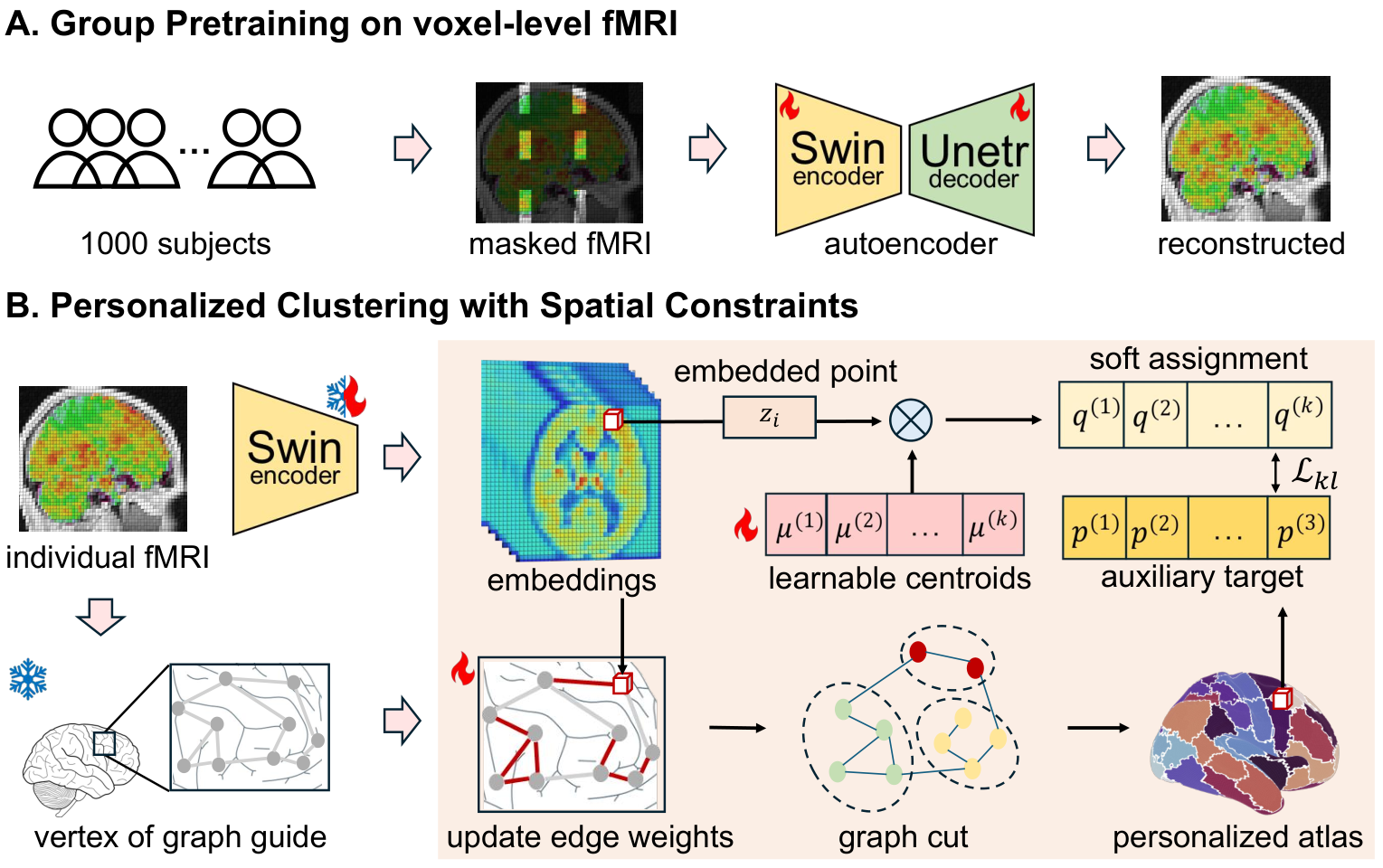
DCA takes a prepared fMRI volume, a mask defining the target brain region and a chosen number of parcels K. The method figure separates feature pretraining from personalized clustering. The output is a voxel-wise parcel map; individual maps can also be combined into a group atlas for comparison and downstream analysis.
Learn a feature vector for each voxel
A Swin-UNETR autoencoder is pretrained by reconstructing masked spatiotemporal blocks. Its embeddings describe voxel signals using information from neighboring locations and time points. Clustering then works on these learned features rather than directly on a noisy raw time series.
Connect nearby voxels by learned similarity
Within the selected mask, each voxel is linked to its spatial neighbors in a sparse graph. Edge weights depend on embedding similarity. Spectral clustering provides auxiliary parcel labels, while soft assignments measure each voxel's affinity to K learnable centers. This brings functional similarity and spatial relationships into the same optimization.
Refine features and cluster centers
An alignment loss makes the soft assignments agree with the graph-derived labels. Iteration updates the cluster centers and the encoder's final projection, with the remaining encoder weights fixed. Users can change the mask and K to obtain a different anatomical scope or granularity, instead of selecting only from a fixed atlas catalog.
Do the parcels agree internally, and help later analysis?
AtlaScore connects two levels of evaluation. Homogeneity measures similarity between signals within a parcel; the silhouette coefficient compares within-parcel coherence with separation from neighboring parcels. Downstream tests then use region-level connectivity features with a simple linear classifier, so the atlas choice is evaluated through a common prediction pipeline.
Compare granularity as well as atlas names
The main quality comparison uses 100 HCP subjects and matches parcel counts. At 200 parcels, DCA improves homogeneity by 77.7% and silhouette by 19.5% over Schaefer. Matching granularity matters because simply increasing the number of parcels can improve these scores even without a better learning method.
Follow the parcels into real tasks
Six main tasks cover HCP traits and task decoding, ABIDE autism classification and ADNI diagnostic classification. DCA is competitive across resolutions, with stronger results on several cognitive and diagnostic tasks; some baseline atlases remain better on individual tasks. CHCP supplies a separate cross-dataset evaluation beyond the HCP construction setting.
| Quality metric | What it tests | Reported relative improvement ↑ |
|---|---|---|
| Functional homogeneity | Similarity within parcels | +77.7% |
| Silhouette coefficient | Within- vs. between-parcel separation | +19.5% |
Choose parcels for the analysis they will support
DCA makes the atlas a learned and configurable part of an fMRI workflow. Its value is not just a cleaner parcel map: the evaluation asks whether the resulting regional signals support useful analyses. A suitable atlas should balance functional coherence, spatial continuity, anatomical coverage and downstream performance at a comparable parcel count.
Build a parcel map or evaluate an existing atlas
The released workflow uses MNI152-space fMRI and registered anatomical masks. Choose a mask and parcel count before running DCA; use AtlaScore to compare quality and downstream behavior. This is an atlas-construction and evaluation workflow, rather than a diagnostic model by itself.
Graph-Guided Deep Embedding Clustering for Brain Atlases
Research post by fMRI Atlas, based on the original study linked above.
Post updated:
Original overview
DCA constructs brain atlases at voxel resolution, using fMRI features to tailor parcels to individual subjects. A pretrained autoencoder supplies the embeddings, while a spatial graph guides clustering so that each parcel stays connected. Users can choose the number of parcels and the brain region to partition. The work also introduces AtlaScore, a benchmark for comparing atlas quality and downstream utility.
Summary of the original paper, revised September 20, 2025 (v2).
BibTeX
@inproceedings{wang2025dca,
  title={DCA: Graph-Guided Deep Embedding Clustering for Brain Atlases},
  author={Wang, Mo and Peng, Kaining and Tang, Jingsheng and Wen, Hongkai and Liu, Quanying},
  year={2025},
  booktitle={Advances in Neural Information Processing Systems},
  volume={38},
  doi={10.52202/085713-3450},
  url={https://papers.nips.cc/paper_files/paper/2025/hash/954729c2c57c32cab97c4f868dbb4d3e-Abstract-Conference.html}
}