
BrainTaskonomy

Learning How to Pretrain and What to Transfer in fMRI Foundation Models

Junfeng Xia, Wenhao Ye, Junxiang Zhang, Jiayu Zuo, Mo Wang, Quanying Liu
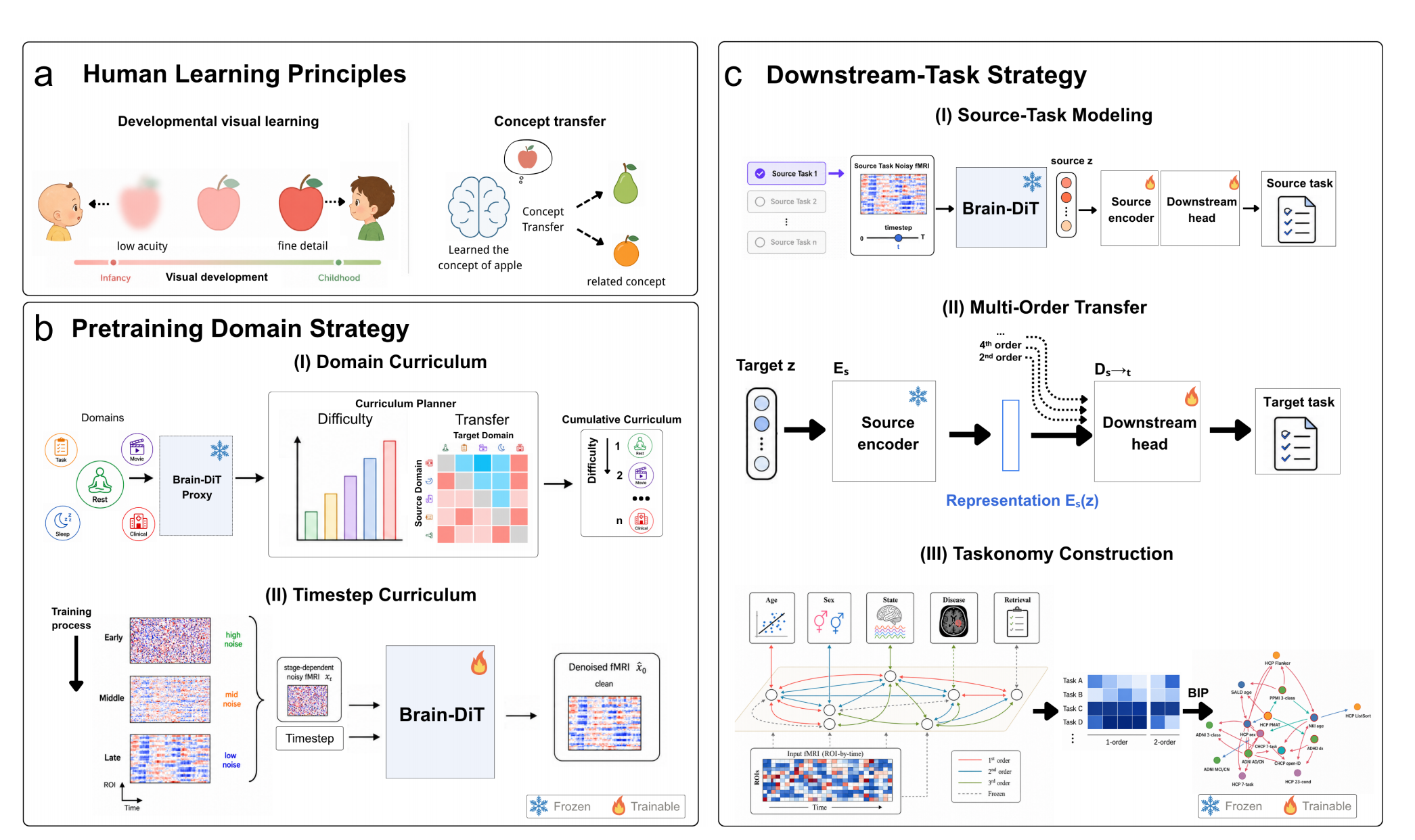
BrainTaskonomy original paper figure
Original paper figure View full figure ↗
At a glance

What this study adds

Summary of the linked study; findings refer to that study’s own comparisons.

Question
Which pretraining domains and source tasks help a target task?
Approach
Measure directed domain and task relationships, then plan curriculum and transfer routes.
Evidence
Ten pretraining domains and fifteen transfer tasks; six in- and out-of-domain downstream tasks.
Finding
The proposed domain-and-timestep curriculum reduces three reconstruction errors versus uniform sampling; transfer gains depend on the target and available routes.

Abstract

fMRI foundation models increasingly aggregate heterogeneous data across brain states, cohorts, and acquisition settings, yet pretraining domains are commonly treated as a flat mixture and downstream tasks are adapted independently. We study whether measured learning relations can organize both stages without modifying the backbone. During pretraining, a lightweight Brain-DiT proxy estimates difficulty and directed facilitation across ten fMRI domains, yielding a priority-guided cumulative domain curriculum combined with high-to-low-noise timestep scheduling and joint consolidation. During adaptation, controlled first- and higher-order transfer across fifteen tasks constructs a directed taskonomy, from which budgeted integer programming (BIP) selects directly supervised source tasks and target-specific routes. The joint priority-domain and high-to-low-timestep curriculum reduces v-NMSE, PSD-NMSE, and FC-MSE by 6.5%, 16.3%, and 10.5%, respectively, relative to uniform sampling over both dimensions, and shows strong downstream performance across six in- and out-of-domain tasks. The taskonomy reveals asymmetric, target-dependent transfer, while exploratory sealed-test evaluation shows larger descriptive gains for BIP policies when higher-order route spaces are available than for matched random controls. Together, these findings support organizing fMRI pretraining and adaptation by measured learning relations rather than treating domains and tasks as independent flat sets.
Method

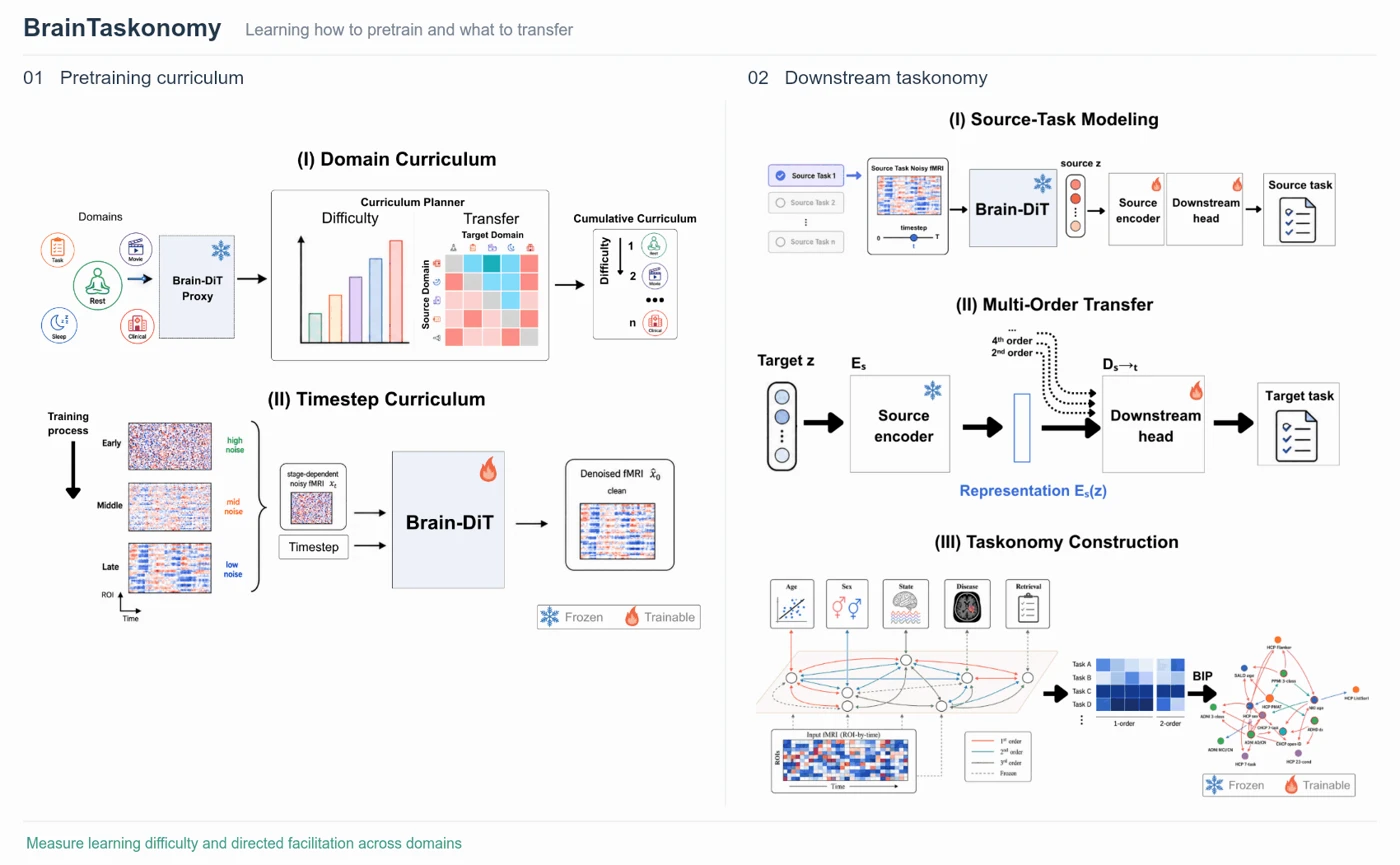
BrainTaskonomy organizes pretraining with measured domain difficulty, directed facilitation, and a cumulative noise-timestep curriculum. For downstream adaptation, controlled single- and multi-source transfer defines a directed taskonomy. Budgeted integer programming selects supervised source tasks and target-specific transfer routes.

Animated BrainTaskonomy framework: domain and timestep curricula, source-task modeling, multi-order transfer, and budget-aware taskonomy construction.

BibTeX

@misc{braintaskonomy2026,
  title={BrainTaskonomy: Learning How to Pretrain and What to Transfer in fMRI Foundation Models},
  author={Xia, Junfeng and Ye, Wenhao and Zhang, Junxiang and Zuo, Jiayu and Wang, Mo and Liu, Quanying},
  year={2026},
  eprint={2609.10518},
  archivePrefix={arXiv},
  url={https://arxiv.org/abs/2609.10518}
}
Continue exploring

fMRI Scaling Study

Next project