
TL;DR. This study varies data, model size and training duration while keeping the NeuroJEPA framework fixed. Across more than 200 source datasets and over 10,000 GPU-hours of experiments, it finds that equal compute can produce different outcomes—and that data and model capacity should be considered together.
If we can afford a larger run, what should we scale?
A larger model or a longer training run can consume more compute without producing the best representation. For fMRI, it is still unclear how additional data, model capacity and optimization time interact.
This study asks a practical question: under a fixed compute budget, which combination should we choose? To make the comparison interpretable, it holds the pretraining framework and downstream evaluation protocol fixed.
Change the scale, keep the learning recipe fixed
A scaling comparison is difficult to interpret if the architecture, learning objective and test protocol all change at once. Here, NeuroJEPA supplies one consistent recipe. The experiments then vary the amount of data, model capacity and training duration around it.
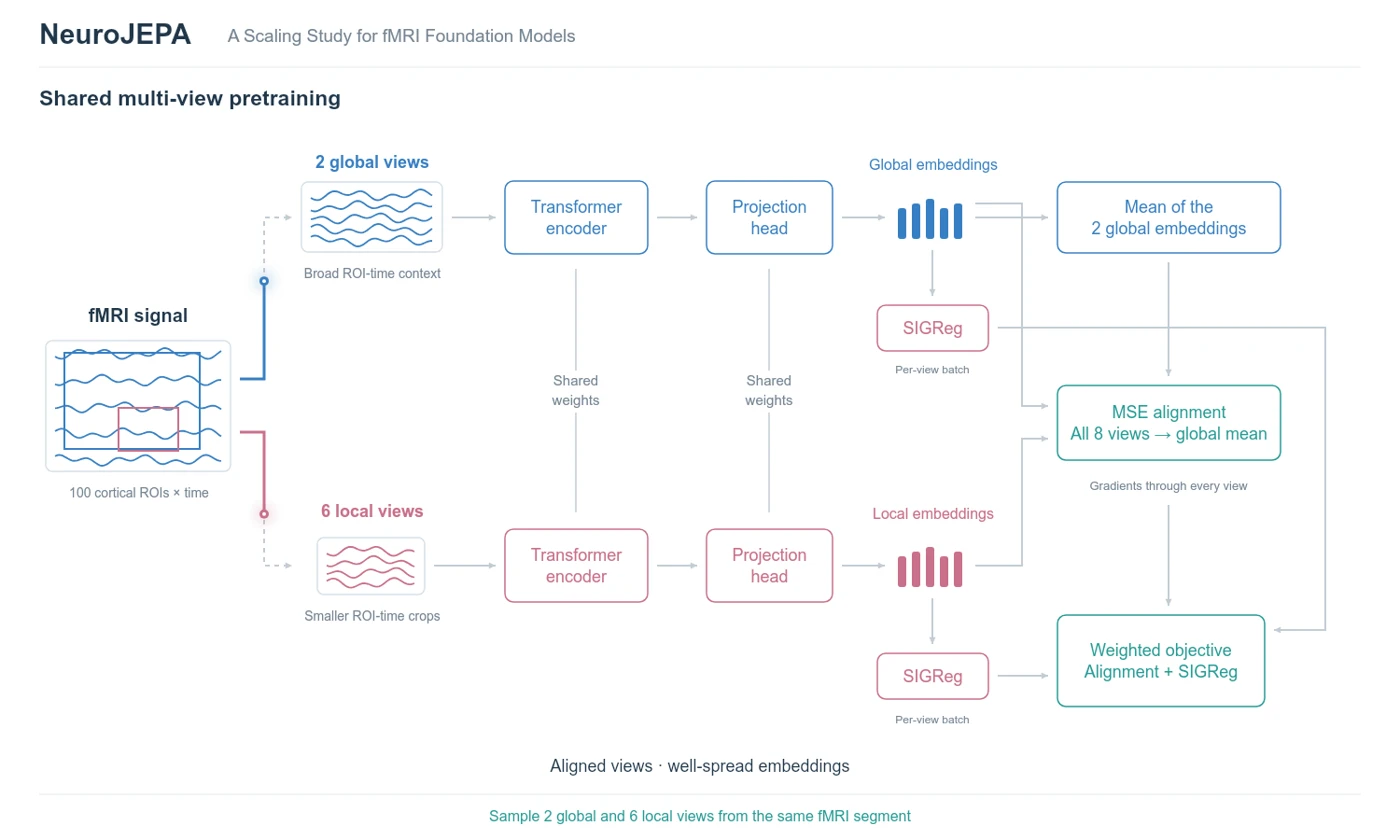
Method overview. Two global and six local views share an encoder and projection head. Each view aligns to the mean global representation, while SIGReg encourages well-spread embeddings. This is the fixed recipe used throughout the scaling experiments. Source paper ↗
Keep the learning recipe fixed
NeuroJEPA encodes two global and six local views with a shared encoder and projection head. Each view is aligned to the mean global representation, while SIGReg encourages well-spread embeddings.
Vary three scaling axes
Using more than 200 source datasets and over 10,000 GPU-hours of experiments, the study varies pretraining data size, model size and training duration. This separates the effects of those choices from changes to the learning method.
Select, lock, then test
In-distribution downstream performance selects configurations at two fixed compute budgets. Those choices are locked before evaluation on out-of-distribution tasks, so the held-out tasks test the selected recipe.
Compute is a budget, not a complete explanation
The results separate a broad trend—more compute generally helps—from the practical choice of how that compute is spent.
Equal compute, different outcomes
Performance generally improves with compute, but models with similar compute can perform substantially differently. Compute alone does not explain the observed scaling behavior.
Data and capacity interact
Additional data bring larger gains at larger model sizes. At matched compute, increasing data benefits more tasks than increasing model size, although the pattern varies by task.
Selection transfers to held-out tasks
The two budget-selected models achieve the highest average performance on the evaluated out-of-distribution tasks among the compared foundation models, while using less pretraining compute.
Choose a recipe before looking at the held-out tasks
The practical lesson is to evaluate combinations of data, capacity and training time, rather than optimize one axis in isolation. The locked out-of-distribution test asks whether a recipe selected on development tasks transfers. The trends describe this fixed framework and remain task-dependent.
Read further
Use this study to design a scaling experiment or choose a training budget allocation. Compare data, capacity and duration jointly, select configurations using development tasks, and reserve separate tasks for the final test. The public repository provides code, pretrained encoder checkpoints, and downstream evaluation examples.
A Scaling Study for fMRI Foundation Models
Research post by fMRI Atlas, based on the original study linked above.
Read the paper’s abstract
Scaling laws have guided large-model development in computer vision and natural language processing, but the relationships among data, model size, and compute remain unclear for functional magnetic resonance imaging (fMRI) foundation models. Here, we conduct a controlled empirical study using pretraining data from more than 200 source datasets and over 10,000 GPU-hours of experiments. Holding the pretraining framework and downstream protocol fixed, we vary pretraining data size, model size, and training duration. Downstream performance generally improves with compute, yet models using similar compute can perform substantially differently. Additional pretraining data bring larger gains at larger model sizes, suggesting that data and model size should be scaled together. At matched compute, increasing pretraining data benefits more tasks than increasing model size, although the pattern varies across tasks. We then use in-distribution (ID) downstream performance to select the combination of pretraining data size, model size, and training duration at two fixed compute budgets. The resulting models are locked before out-of-distribution (OOD) evaluation. They achieve the highest average performance across the evaluated OOD tasks among the compared fMRI foundation models while using less pretraining compute. Overall, our results show that compute alone does not characterize fMRI scaling: performance depends on how pretraining data, model size, and training duration are combined.
BibTeX
@misc{scalingstudy2026,
  title={A Scaling Study for fMRI Foundation Models},
  author={Ye, Wenhao and Pan, Xuanye and Xia, Junfeng and Zhang, Junxiang and Wang, Mo and Liu, Quanying},
  year={2026},
  eprint={2609.27232},
  archivePrefix={arXiv},
  url={https://arxiv.org/abs/2609.27232}
}