
SLIM-Brain

Adaptive Sparse Routing for Voxel-Level fMRI Foundation Models

Mo Wang, Junfeng Xia, Wenhao Ye, Enyu Liu, Kaining Peng, Jianfeng Feng, Quanying Liu, Hongkai Wen
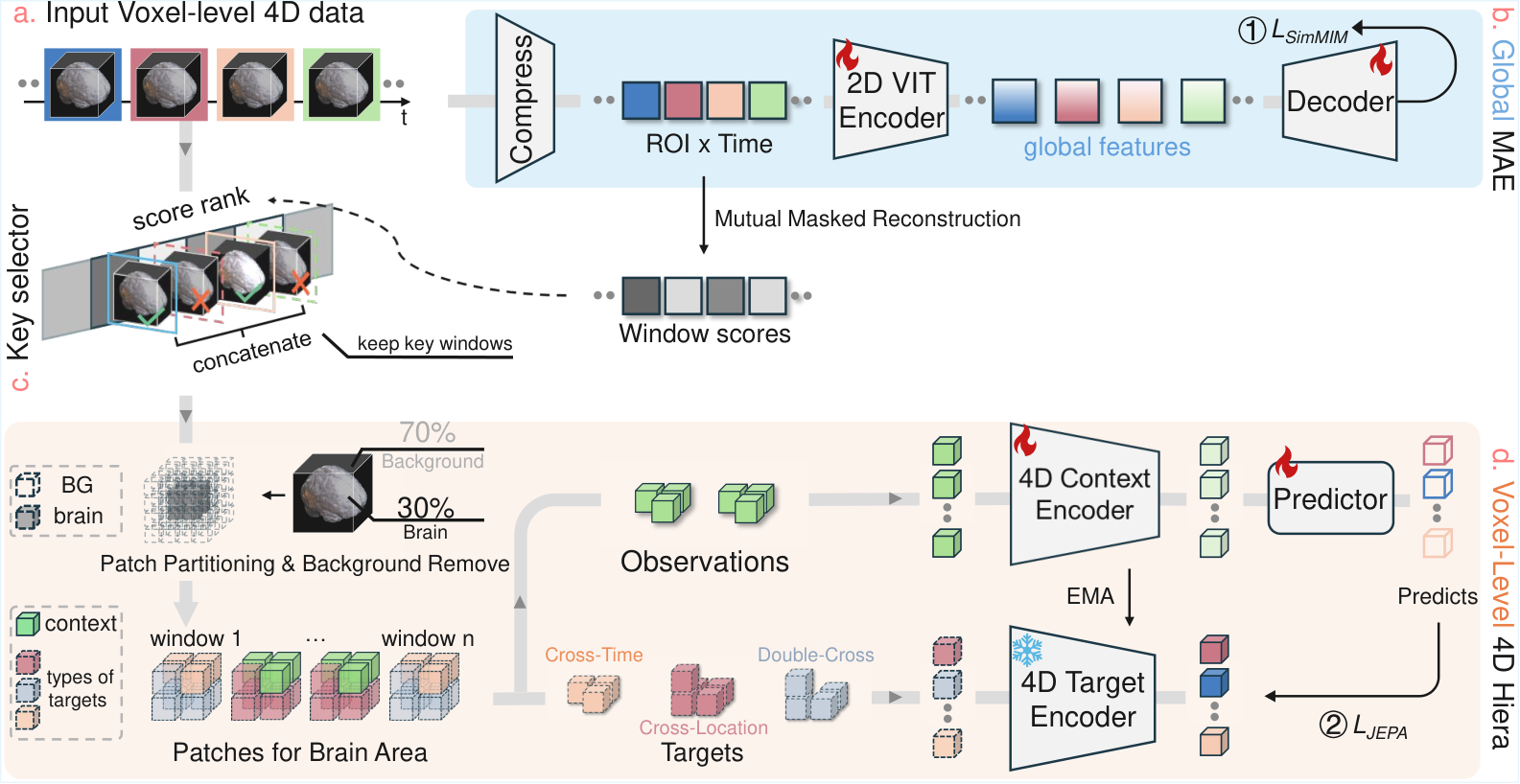
SLIM-Brain original paper figure
Original paper figure View full figure ↗
At a glance

What this study adds

Summary of the linked study; findings refer to that study’s own comparisons.

Question
Can voxel-level learning use less data and memory?
Approach
Rank temporal windows globally and route selected windows to a sparse 4D encoder.
Evidence
About 4,000 pretraining sessions and external public benchmarks.
Finding
The paper reports strong benchmark performance using about 30% of the GPU memory of its Swin-based voxel comparison.

Abstract

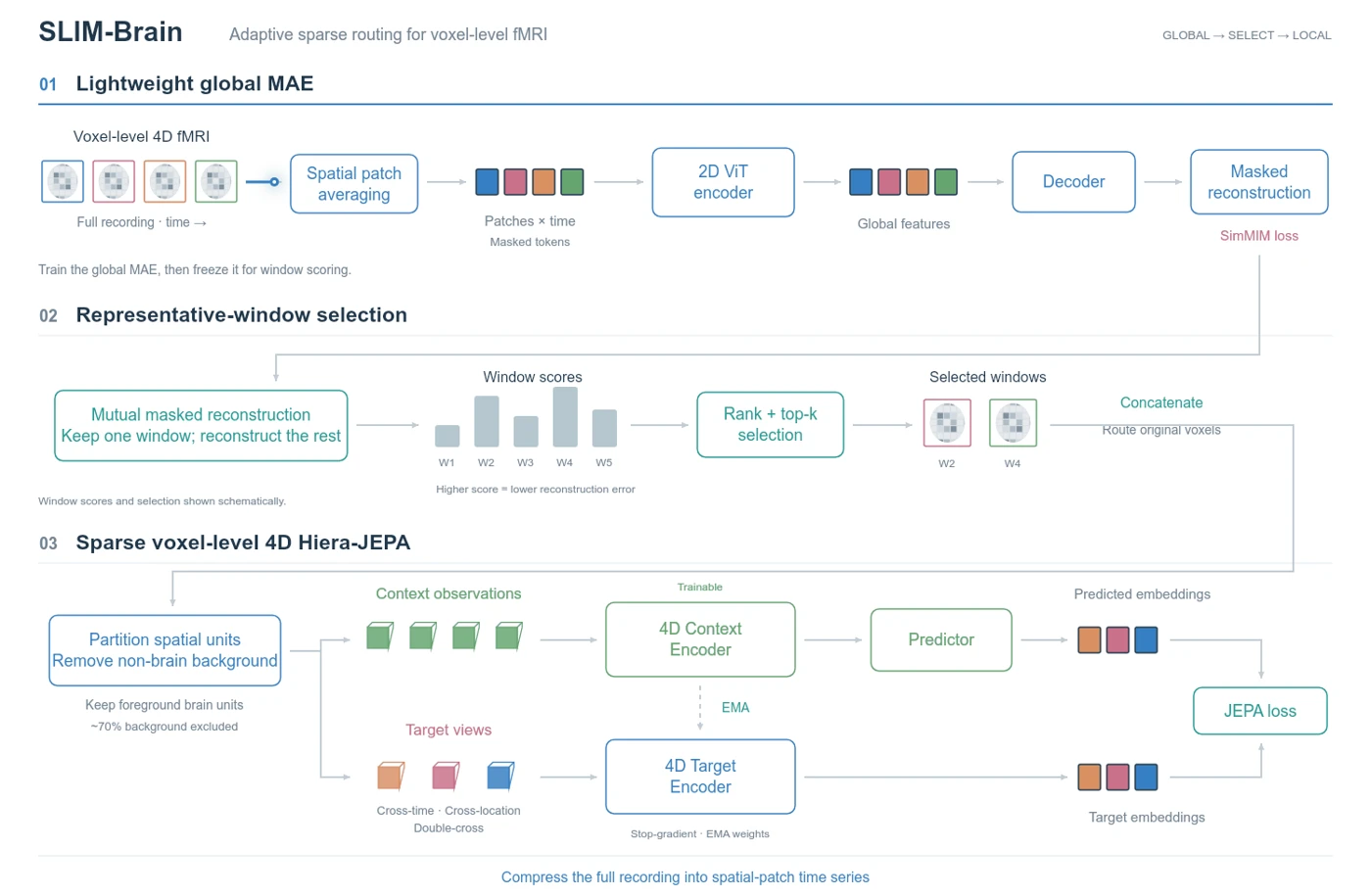
Foundation models are emerging as a powerful paradigm for fMRI analysis; however, current approaches are hindered by a dual bottleneck in data and computational efficiency. Atlas-based methods aggregate voxel signals into fixed regions of interest (ROIs), which reduces dimensionality but discards fine-grained spatial details and necessitates massive cohorts for effective pre-training. Conversely, atlas-free methods operate directly on voxel-level data to preserve spatial fidelity, but their memory and compute requirements often make end-to-end voxel-level processing of full-length fMRI sequences impractical. In this work, we introduce SLIM-Brain, an atlas-free foundation model that uses a lightweight global encoder to score temporal windows from long fMRI recordings while applying voxel-level computation only to the selected windows. SLIM-Brain adopts a two-stage adaptive design: (i) a lightweight temporal extractor ranks windows by how well they represent the remainder of the recording, and (ii) a 4D hierarchical encoder (Hiera-JEPA) learns fine-grained voxel-level representations only from the top-k representative windows while pruning approximately 70% of non-brain or masked units. The downstream predictor uses the voxel-level descriptor; the global encoder is used only for routing. Extensive experiments across external public benchmarks show that SLIM-Brain achieves strong performance on diverse tasks while requiring only about 4 thousand pre-training sessions and approximately 30% of the GPU memory used by Swin-based voxel-level models.
Method

A lightweight global MAE scores temporal windows across the full recording. Only the top-k representative windows are routed to a sparse 4D Hiera-JEPA encoder, which learns fine-grained voxel-level representations through context and target branches.

Animated SLIM-Brain pipeline: global masked autoencoding, representative-window selection, and sparse voxel-level 4D Hiera-JEPA learning.
Global MAEWindow selection4D Hiera-JEPAView full-size animation ↗

BibTeX

@misc{slimbrain2025,
  title={SLIM-Brain: A Data- and Training-Efficient Foundation Model for fMRI Data Analysis},
  author={Wang, Mo and Xia, Junfeng and Ye, Wenhao and Liu, Enyu and Peng, Kaining and Feng, Jianfeng and Liu, Quanying and Wen, Hongkai},
  year={2025},
  eprint={2512.21881},
  archivePrefix={arXiv},
  url={https://arxiv.org/abs/2512.21881}
}
Continue exploring

FlexiBrain

Next project