Summary of the linked study; findings refer to that study’s own comparisons.
Question
Can a single voxel encoder learn from native scans with different resolutions?
Approach
Physical-space patching with dynamic kernel resizing and a Mamba-JEPA backbone.
Evidence
Five diagnostic tasks across ABIDE, ADHD-200, ADNI, and external PPMI evaluation.
Finding
The paper reports stronger results than its compared methods across five tasks while avoiding template-space warping.
Overview
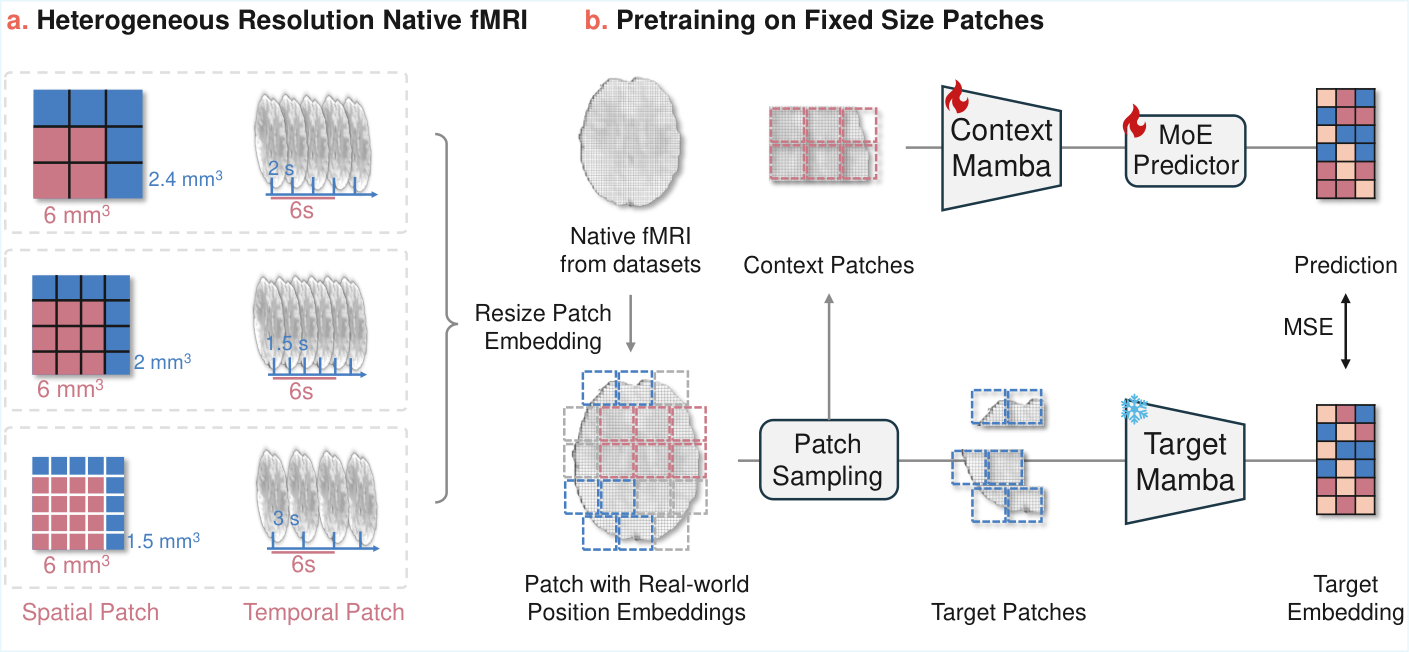
FlexiBrain learns voxel-level representations from native-space fMRI acquired at different spatial and temporal resolutions. It specifies patch sizes in physical units and resizes shared embedding kernels to match each scan, allowing one encoder to handle heterogeneous acquisitions without first warping every subject to a common template. A Mamba-JEPA backbone learns by predicting masked latent features rather than reconstructing the raw signal. A mixture-of-experts module in the context branch helps stabilize learning. The study evaluates five diagnostic tasks across ABIDE, ADHD-200, ADNI and PPMI, with PPMI used as an external dataset.
Resolution-aware tokenization adapts shared patch embeddings to each scan. Context and target branches then learn predictive representations in latent space.
@misc{wang2026flexibrain,
  title={FlexiBrain: Resolution-Agnostic Voxel-Level Encoding for Native fMRI},
  author={Wang, Mo and Ye, Wenhao and Xia, Junfeng and Xu, Minghao and Wen, Hongkai and Liu, Quanying},
  year={2026},
  eprint={2606.11500},
  archivePrefix={arXiv},
  primaryClass={eess.IV},
  doi={10.48550/arXiv.2606.11500},
  url={https://arxiv.org/abs/2606.11500}
}