Summary of the linked study; findings refer to that study’s own comparisons.
Question
Can voxel-level pretraining retain spatial detail at larger scale?
Approach
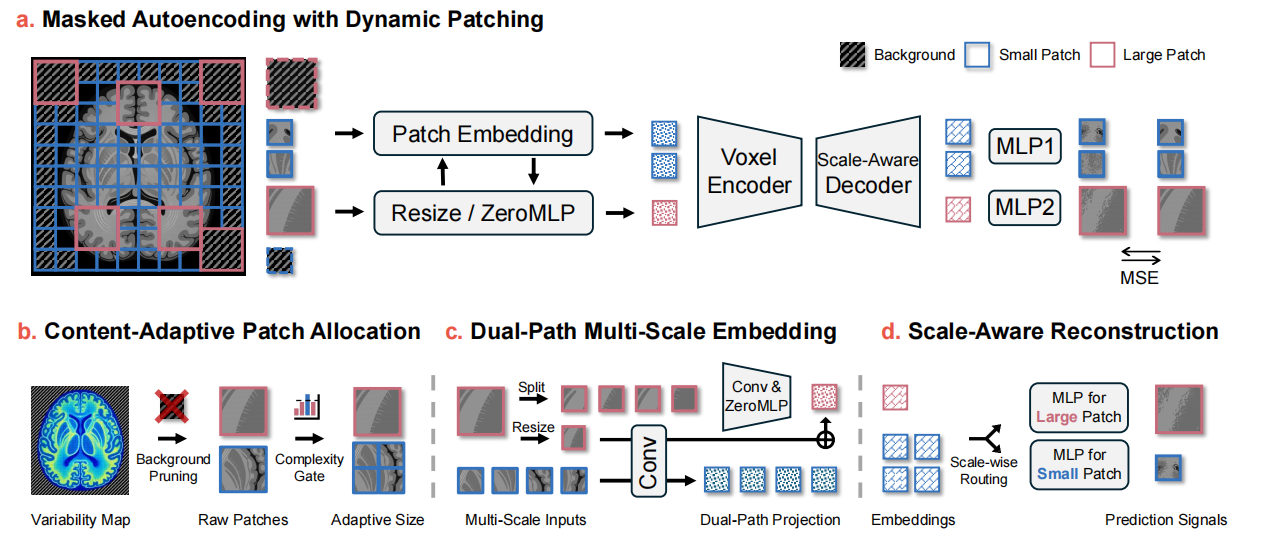
Atlas-free encoding with content-adaptive voxel patches and scale-specific reconstruction.
Evidence
49,497 pretraining sessions from nine datasets; benchmark suite spanning eleven datasets.
Finding
The paper reports improvements over its evaluated foundation-model baselines across resting-state and task-based benchmarks.
Abstract
Self-supervised fMRI foundation models have shown promising transfer performance, yet most rely on predefined region-level parcellations that discard fine-grained voxel information and introduce atlas-dependent biases. We propose Omni-fMRI, an atlas-free foundation model that operates directly on voxel-level signals. To enable scalable pretraining on 49,497 fMRI sessions across nine datasets, Omni-fMRI introduces a dynamic patching mechanism that substantially reduces computational cost while preserving informative spatial structure. To support reproducibility and fair comparison, we establish a comprehensive benchmark suite spanning 11 datasets and a diverse set of resting-state and task-based fMRI tasks. Experimental results demonstrate that Omni-fMRI consistently outperforms existing foundation models, providing a scalable and reproducible framework for atlas-free brain representation learning.
Method
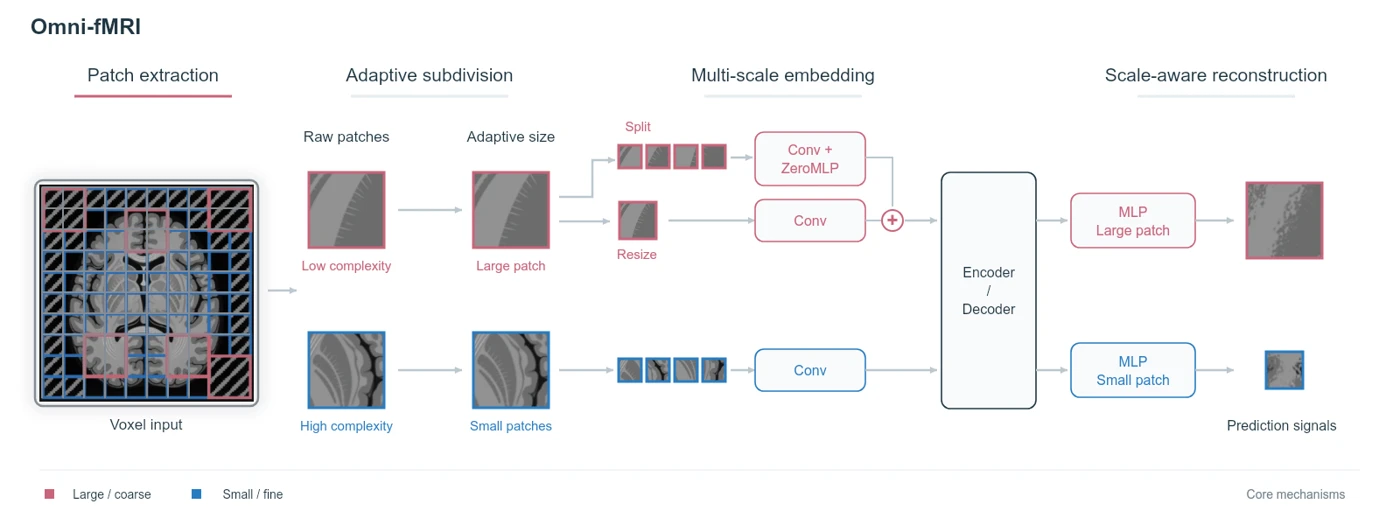
Omni-fMRI adaptively allocates coarse and fine voxel patches, aligns them through a dual-path embedding, then reconstructs each scale with dedicated prediction heads.
Large / coarse patchesSmall / fine patches
BibTeX
@article{wang2026omnifmri,
  title={Omni-fMRI: A Universal Atlas-Free fMRI Foundation Model},
  author={Wang, Mo and Ye, Wenhao and Xia, Junfeng and Zhang, Junxiang and Pan, Xuanye and Xu, Minghao and Deng, Haotian and Wen, Hongkai and Liu, Quanying},
  journal={arXiv preprint arXiv:2601.23090},
  year={2026},
  url={https://arxiv.org/abs/2601.23090},
  doi={10.48550/arXiv.2601.23090}
}