
Brain-DiT

A Universal Multi-state fMRI Foundation Model with Metadata-Conditioned Pretraining

Junfeng Xia, Wenhao Ye, Xuanye Pan, Xinke Shen, Mo Wang, Quanying Liu
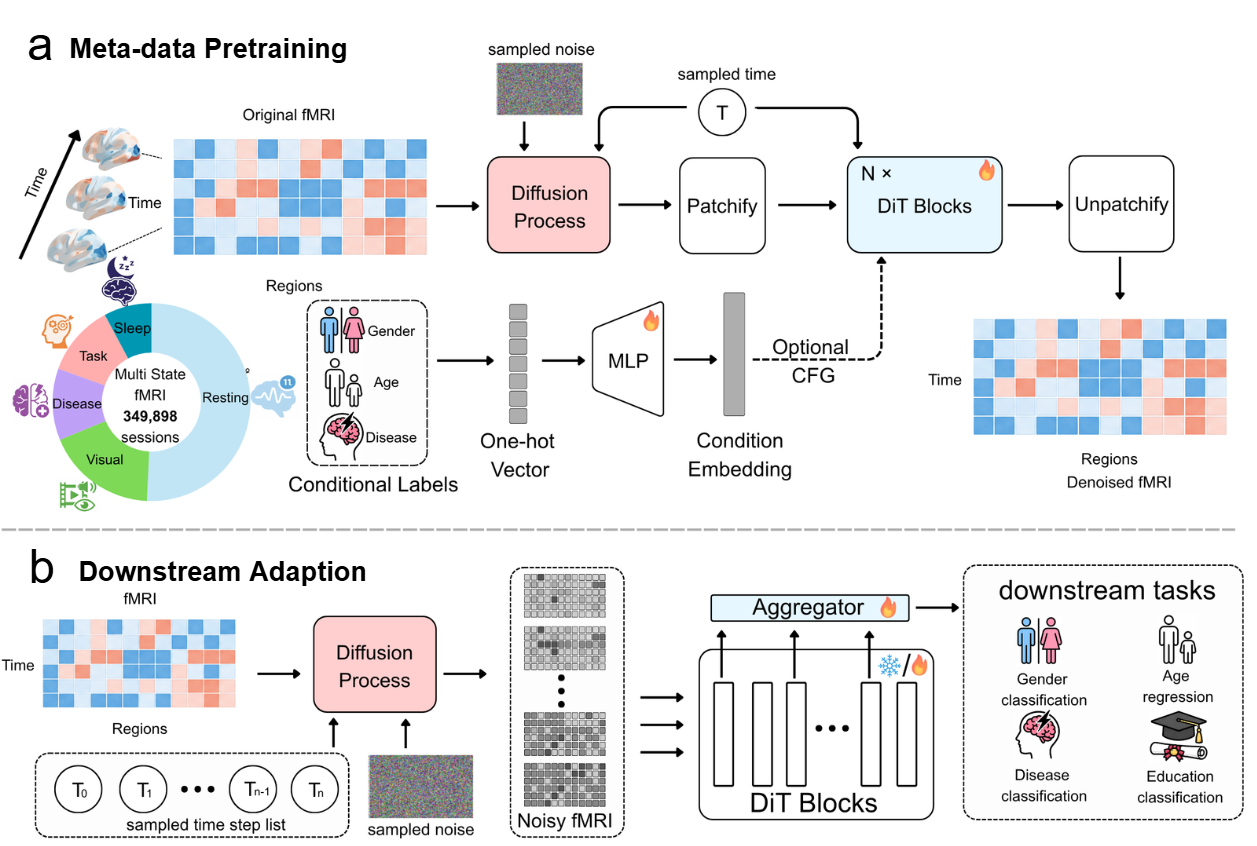
MICCAI 2026 · Best Paper ShortlistBrainDiT original paper figure
Original paper figure View full figure ↗
At a glance

What this study adds

Summary of the linked study; findings refer to that study’s own comparisons.

Question
Can one model transfer across distinct brain states?
Approach
Metadata-conditioned diffusion pretraining of ROI time series.
Evidence
349,898 sessions from 24 datasets; seven downstream tasks.
Finding
The paper reports stronger downstream transfer than its reconstruction and alignment comparisons; preferred representation scale varies by task.

Abstract

Current fMRI foundation models primarily rely on a limited range of brain states and mismatched pretraining tasks, restricting their ability to learn generalized representations across diverse brain states. We present Brain-DiT, a universal multi-state fMRI foundation model pretrained on 349,898 sessions from 24 datasets spanning resting, task, naturalistic, disease, and sleep states. Unlike prior fMRI foundation models that rely on masked reconstruction in the raw-signal space or a latent space, Brain-DiT adopts metadata-conditioned diffusion pretraining with a Diffusion Transformer (DiT), enabling the model to learn multi-scale representations that capture both fine-grained functional structure and global semantics. Across extensive evaluations and ablations on 7 downstream tasks, we find consistent evidence that diffusion-based generative pretraining is a stronger proxy than reconstruction or alignment, with metadata-conditioned pretraining further improving downstream performance by disentangling intrinsic neural dynamics from population-level variability. We also observe that downstream tasks exhibit distinct preferences for representational scale: ADNI classification benefits more from global semantic representations, whereas age/sex prediction comparatively relies more on fine-grained local structure. Code and parameters of Brain-DiT are available at the code repository.
Method

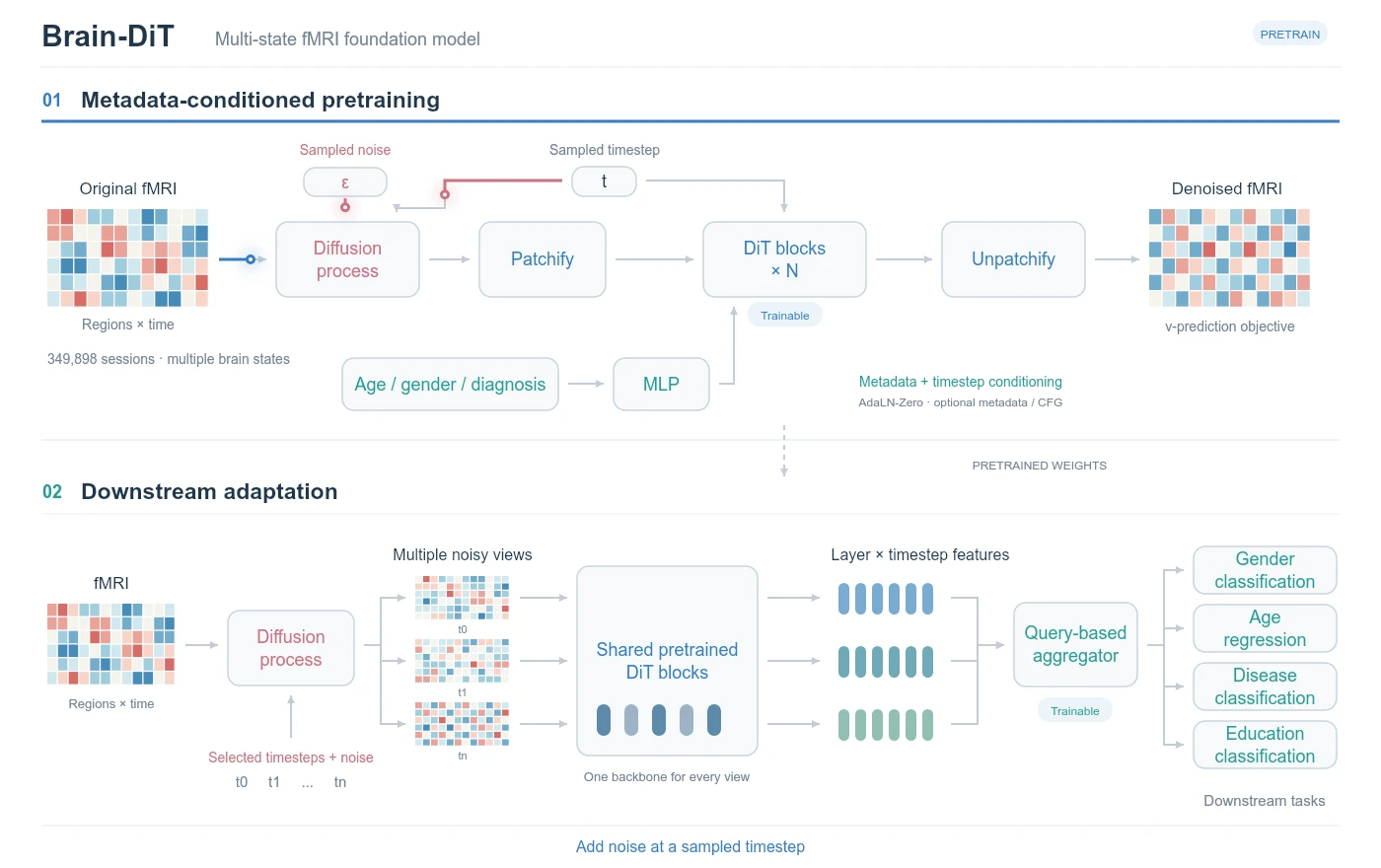
Brain-DiT learns from multi-state fMRI through metadata-conditioned diffusion pretraining. For downstream tasks, a shared pretrained DiT extracts features across noise timesteps and network layers, which a query-based aggregator combines for classification and regression.

Animated Brain-DiT framework: metadata-conditioned pretraining above and downstream adaptation below.
PretrainingDownstream adaptationView full-size animation ↗

BibTeX

@inproceedings{xia2026braindit,
  title={Brain-DiT: A Universal Multi-state fMRI Foundation Model with Metadata-Conditioned Pretraining},
  author={Xia, Junfeng and Ye, Wenhao and Pan, Xuanye and Shen, Xinke and Wang, Mo and Liu, Quanying},
  year={2026},
  booktitle={Medical Image Computing and Computer Assisted Intervention -- MICCAI 2026},
  publisher={Springer Nature Switzerland},
  volume={16894},
  url={https://papers.miccai.org/miccai-2026/0120-Paper1362.html}
}
Continue exploring

BrainWorld

Next project