
fMRI Scaling Study

A Scaling Study for fMRI Foundation Models

Wenhao Ye1,2, Xuanye Pan1, Junfeng Xia1, Junxiang Zhang1,4, Mo Wang1,3,†, Quanying Liu1,†
1Southern University of Science and Technology   2Shenzhen University   3University of Warwick   4SLAI

† Equal author

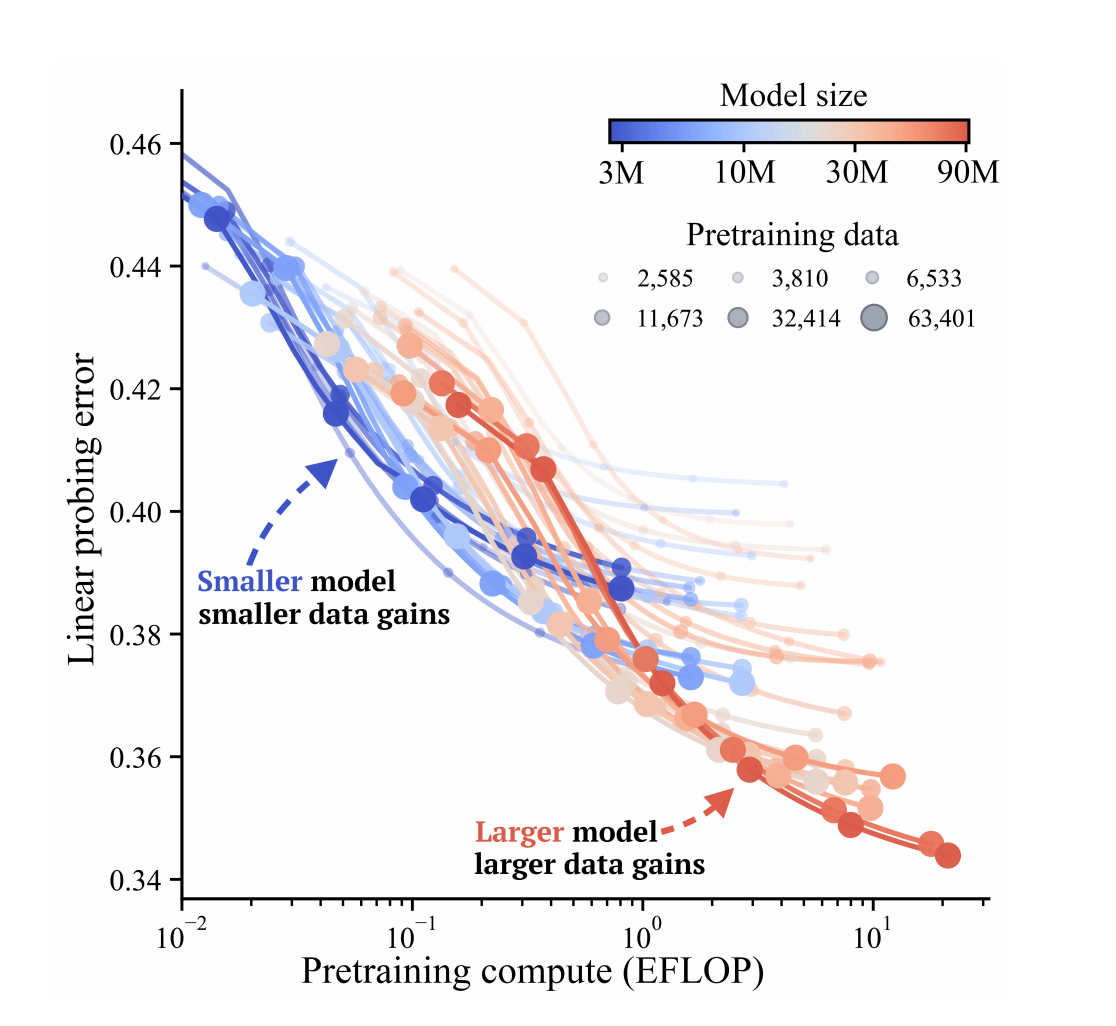
Scaling Study original paper figure
Original paper figure View full figure ↗
At a glance

What this study adds

Summary of the linked study; findings refer to that study’s own comparisons.

Question
How do data, model size, and training time interact at fixed compute?
Approach
Vary those three factors under a controlled pretraining and evaluation protocol.
Evidence
More than 200 source datasets and over 10,000 GPU-hours of experiments.
Finding
At matched compute, increasing data benefits more evaluated tasks than increasing model size, with task-dependent variation.

Abstract

Scaling laws have guided large-model development in computer vision and natural language processing, but the relationships among data, model size, and compute remain unclear for functional magnetic resonance imaging (fMRI) foundation models. Here, we conduct a controlled empirical study using pretraining data from more than 200 source datasets and over 10,000 GPU-hours of experiments. Holding the pretraining framework and downstream protocol fixed, we vary pretraining data size, model size, and training duration. Downstream performance generally improves with compute, yet models using similar compute can perform substantially differently. Additional pretraining data bring larger gains at larger model sizes, suggesting that data and model size should be scaled together. At matched compute, increasing pretraining data benefits more tasks than increasing model size, although the pattern varies across tasks. We then use in-distribution (ID) downstream performance to select the combination of pretraining data size, model size, and training duration at two fixed compute budgets. The resulting models are locked before out-of-distribution (OOD) evaluation. They achieve the highest average performance across the evaluated OOD tasks among the compared fMRI foundation models while using less pretraining compute. Overall, our results show that compute alone does not characterize fMRI scaling: performance depends on how pretraining data, model size, and training duration are combined.
Method

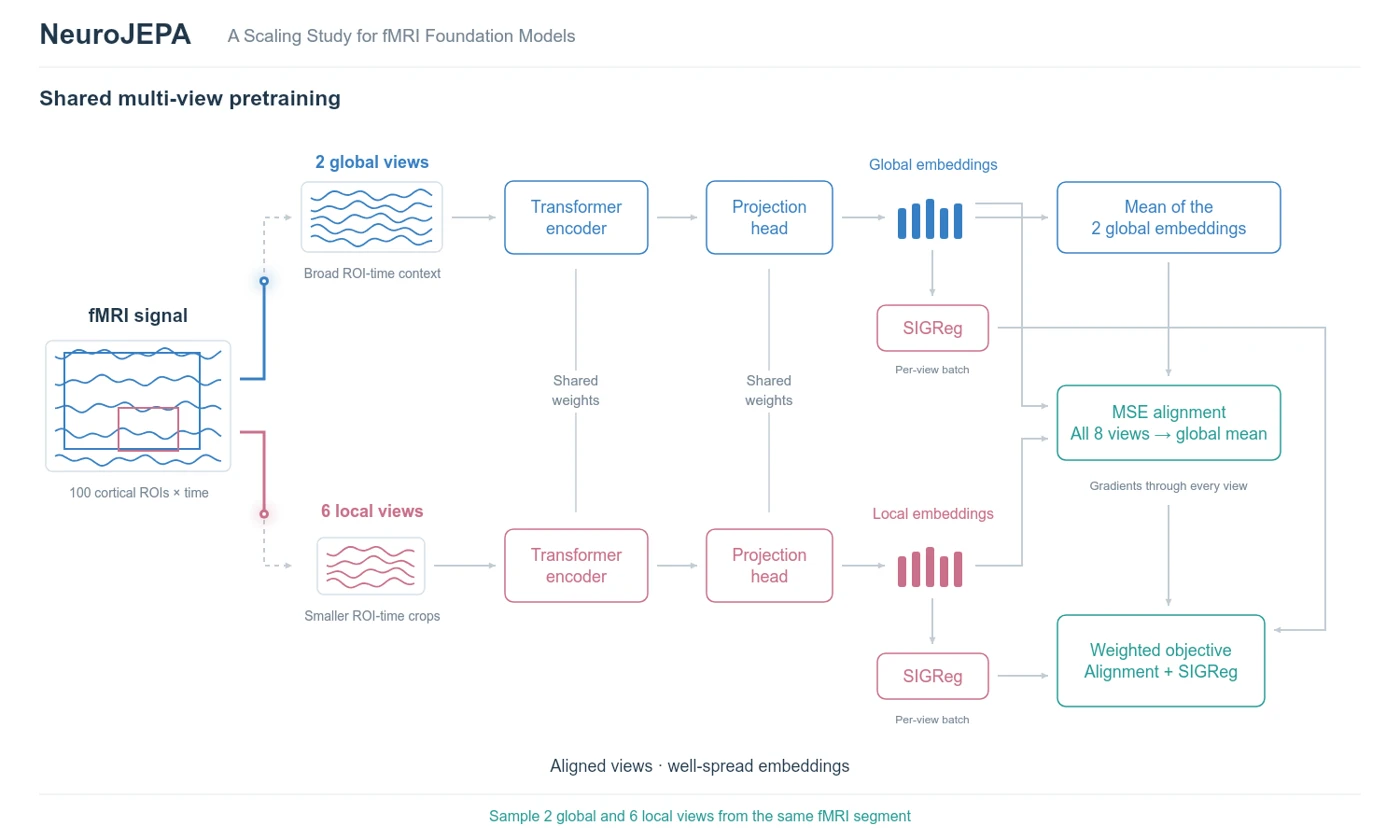
NeuroJEPA provides the fixed pretraining method for the scaling study. Two global and six local views share an encoder and projection head. Every view is aligned to the mean global representation, while SIGReg encourages well-spread embeddings. The study varies pretraining data size, model size, and training duration under a fixed evaluation protocol.

Animated NeuroJEPA pretraining: shared global and local view encoding, mean-global alignment, and per-view SIGReg.
Global viewsLocal viewsView full-size animation ↗

BibTeX

@misc{scalingstudy2026,
  title={A Scaling Study for fMRI Foundation Models},
  author={Ye, Wenhao and Pan, Xuanye and Xia, Junfeng and Zhang, Junxiang and Wang, Mo and Liu, Quanying},
  year={2026},
  eprint={2609.27232},
  archivePrefix={arXiv},
  url={https://arxiv.org/abs/2609.27232}
}
Continue exploring

FlatClip

Next project